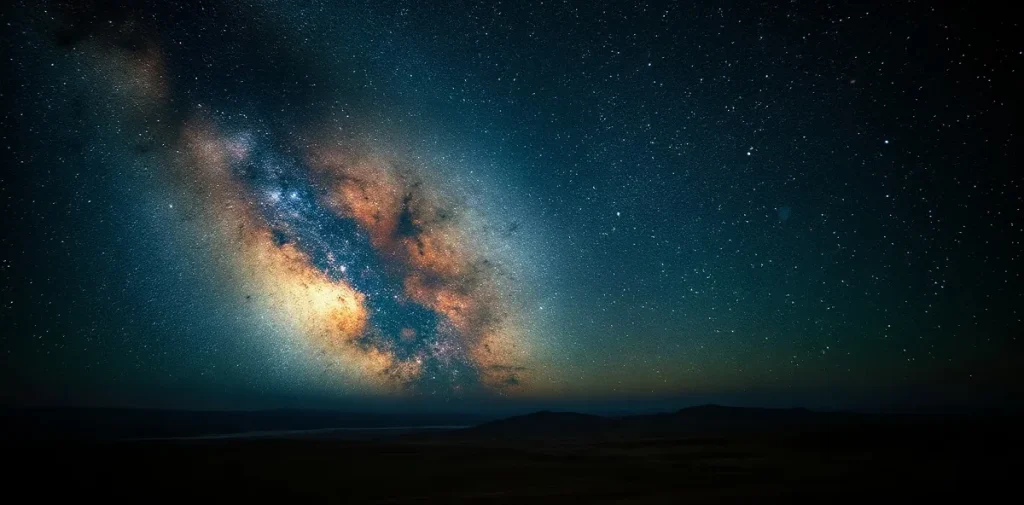
We explore the universe by observing light and other signals from space, studying celestial bodies with telescopes, and sending spacecraft to investigate them. This is how scientists learn about the structure of planets, stars, and galaxies.
A story of space is a story of how observations become knowledge: the light from a distant star helps scientists study its properties, while images of planets reveal details of their surfaces. Each method of investigation answers some questions and leaves others open.
| Stage | What is examined | What to check |
|---|---|---|
| Observations | The sky and celestial bodies | What was directly observed |
| Discoveries | Conclusions about nature and the universe | Which observation the conclusion is based on |
| Space expeditions | Exploration beyond Earth | The mission’s goal and its result |
| Exploration of celestial bodies | Stations and their purpose | Notification to the United Nations |
What does space tell us about the universe?
Observations of space help us study celestial bodies and the laws of nature: astronomers investigate stars’ properties by studying their light, while planets allow us to compare different worlds. Space research has expanded our understanding of the universe and connected astronomical discoveries with advances in physics and other related fields.
The United States and the former Soviet Union led the space race; there were no other contenders. The rivalry between these two major participants became part of space exploration, but its significance goes beyond competition: observations of space created new opportunities to study nature.
Observation, conclusion, and hypothesis
A story about space is more precise when it distinguishes among three levels. An observation is recorded light or the movement of a celestial body. A conclusion explains what has been observed using the laws of physics. A hypothesis remains a possible explanation until further observations confirm it.
- Observation: what exactly was recorded by a telescope or spacecraft.
- Conclusion: which explanation is consistent with the observation and established physics.
- Hypothesis: what still needs to be tested with additional data.
This distinction helps show where measurement ends and explanation begins.
How did the history of space exploration begin?
Space exploration began more than six decades ago, when the study of the universe started to move beyond observation to space expeditions.
From observations to expeditions
Observations allow us to study celestial bodies from Earth; expeditions added the ability to explore space directly. This transition broadened the ways of studying nature and contributed to the development of related fields, including physics.
The history of space exploration is easy to trace through its pioneers and specific missions. This approach helps distinguish events associated with the beginnings of spaceflight from discoveries made later.
The space race
The United States and the former Soviet Union led the space race; there were no other contenders. Their rivalry became the main thread in the early history of space exploration.
- Pioneers show who opened the way to space and how they did it.
- Specific missions make it possible to trace what was studied and how methods of exploring the universe changed.
- Later discoveries should be considered separately rather than attributed to the first expeditions.
How do space missions change scientific understanding?
Space missions change scientific understanding when observations and research beyond Earth provide grounds for revising earlier explanations of how the universe works.
A mission turns a scientific question into a test: researchers choose what to observe or study, then compare the results with existing explanations. Observations from space broaden our access to the natural world and help physics develop alongside other fields of science.
Observation and conclusion are not the same thing
It is important to describe a mission’s results in two distinct steps. First, state exactly what was observed or studied beyond Earth; then explain what conclusion was drawn from the result. An observation alone does not explain how the universe works: it must be connected to a scientific question.
- Observation: what the mission studied and what result it obtained.
- Conclusion: which explanation the result supports or prompts scientists to reconsider.
This sequence shows how space research connects with physics: an observation provides grounds for testing ideas about nature, and a new result can change an earlier explanation. When describing a mission, it is important not to confuse what was observed with what scientists concluded from those observations.
Who is involved in space projects today?
Government programs and private companies, including SpaceX and Blue Origin, take part in space projects.
SpaceX and Blue Origin have broadened participation in space exploration beyond government programs. However, a company’s name alone does not explain what is happening in a project: the same organization may be involved in different missions and activities.
How to distinguish the participants in a project
- Company — an organization involved in space activities, such as SpaceX or Blue Origin.
- Mission — a specific flight or expedition. It should not be confused with the company involved in the project.
- Scientific goal — the question an expedition is intended to help answer. It describes the purpose of the research, not the name of a participant.
To find out who is involved in a specific expedition and what it is studying, check its official description: this can clarify the participants, the course of the mission, and its scientific goal.
What rules govern the exploration of celestial bodies?
When exploring celestial bodies, the United Nations must be notified of the location and purpose of any stations on celestial bodies.
This requirement applies specifically to stations on celestial bodies. It should not automatically be extended to every spacecraft: a station and a spacecraft sent to a celestial body are not the same thing.
Scientific objectives and rules for activities
A mission’s scientific goal and the rules governing activities on a celestial body are separate matters. The research objective explains what the mission is studying; notification about a station concerns its location and purpose.
Before describing a particular station, determine its purpose and check which international rules apply to the activity. This helps avoid confusing requirements for stations with rules concerning other spacecraft.
How can you read and fact-check a story about space?
A story about space is easier to fact-check if you distinguish observations from scientific conclusions and mission plans, and verify expedition names against their official descriptions.
Books about space help reconstruct the sequence: what was observed first, which discoveries changed our understanding of the universe, and how expeditions developed. But a coherent narrative does not make every statement in it equally reliable: the role of each fact matters.
- Observation — something that was recorded or seen. Check whether the author is describing an observational result or already explaining it.
- Scientific conclusion — an interpretation of observations. Check whether the conclusion is distinguished from the phenomenon itself.
- Mission plan — an intention to undertake an expedition or carry out a task. A project description does not confirm that a launch took place or that the goal was achieved.
Check mission names, participants, and dates against official descriptions of the specific expeditions. Verify not only the wording but also the status of the event: a plan, a mission that has taken place, and a confirmed scientific result are different things.
What to check in a book
Space research in the twentieth century broadened our understanding of nature and influenced related fields, including physics. If a book links a discovery to scientific progress, look for the specific observation behind the conclusion and identify which expedition the account refers to; then verify the mission’s name and participants against its official record.
Frequently asked questions
What does the history of space exploration cover?
Who led the space race?
Which private companies take part in space projects?
What must the United Nations be notified about?
Key takeaways
- Space exploration began more than six decades ago.
- The United States and the former Soviet Union led the space race.
- SpaceX and Blue Origin take part in space projects.
- The United Nations must be notified of the location and purpose of stations on celestial bodies.
Sources
- tukai-rt.ru — “How the Twentieth Century Changed Our Understanding of the Universe”
- United Nations — “Outer Space”