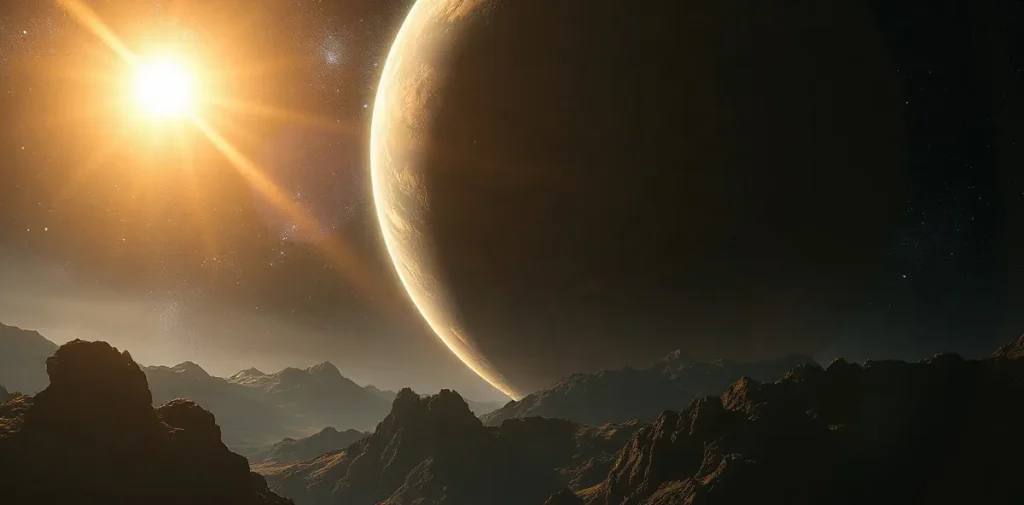
The mass and composition of an exoplanet directly determine the characteristics of its atmosphere: more massive planets retain dense gas envelopes, while lighter bodies often have thin or nonexistent atmospheres. Chemical composition affects temperature, pressure, and stability of atmospheric layers, creating unique climate conditions.
Studying the diversity of exoplanets reveals how varied their atmospheres can be depending on the planet’s mass and composition. These factors influence gas accumulation and retention processes, as well as interactions with stellar radiation, ultimately shaping climate and potential habitability.
Understanding how mass and composition impact exoplanet atmospheres opens new horizons in astronomy and astrophysics, allowing not only classification of discovered planets but also prediction of their physical properties and life-supporting potential.
| Planet | Mass (Earth masses) | Main atmospheric gas | Atmospheric density (kg/m³) |
|---|---|---|---|
| Mercury | 0.055 | None or extremely thin | <0.00001 |
| Mars | 0.107 | CO2 (95%) | 0.020 |
| Earth | 1 | Nitrogen (78%) | 1.2 |
| Jupiter | 317 | Hydrogen (89%) | 0.16 (upper layers) |
- 317 Earth masses Mass of Jupiter
- 95% CO2 content in Mars’ atmosphere
- 78% Nitrogen fraction in Earth’s atmosphere
- 1 Earth mass Mass of Earth
How Does a Planet’s Mass Influence the Formation of Its Atmosphere?
The Mass Threshold for Atmosphere Retention
A planet’s mass directly determines its ability to retain an atmosphere, especially light gases such as hydrogen and helium. Planets with masses greater than 10 Earth masses can form thick gas envelopes, retaining light gases thanks to strong gravity. For masses below 0.1 Earth masses, gravitational pull is too weak to hold an atmosphere, particularly under solar wind pressure.
Examples from the Solar System
Jupiter, with a mass of 317 Earth masses, has a dense atmosphere primarily composed of hydrogen and helium. This is confirmed by NASA’s Juno mission, which studied Jupiter’s atmospheric structure and composition from 2011 to 2025. Conversely, Mercury, with about 0.055 Earth masses, is nearly airless due to weak gravity and constant solar wind exposure. Earth, with a mass exactly 1 Earth mass, holds a moderately dense atmosphere of 78% nitrogen and 21% oxygen, creating conditions suitable for life.
- Jupiter’s mass: 317 Earth masses — dense gas atmosphere of hydrogen and helium
- Earth’s mass: 1 Earth mass — atmosphere of 78% nitrogen and 21% oxygen
- Mercury’s mass: about 0.055 Earth masses — practically no atmosphere
- Light gas retention threshold: over 10 Earth masses
- Atmosphere loss threshold due to weak gravity: under 0.1 Earth masses
Why Does a Planet’s Composition Affect Its Atmosphere Type?
A planet’s composition defines the type of its atmosphere because chemical and mineral makeup influences gravity, surface presence, and chemical reactions that form the gas envelope. Planets with iron-silicate cores typically have thin atmospheres, while gas giants rich in hydrogen and helium possess dense, thick gas layers.
The Influence of Mineralogy on the Atmosphere
A planet’s mineralogical composition sets the foundation for its atmospheric formation. Planets high in iron and silicates, like Mars, develop solid surfaces and predominantly retain carbon dioxide, which makes up about 95% of the Martian atmosphere. Meanwhile, gas giants such as Saturn are composed of about 96% hydrogen, owing to their mass and ability to hold light gases. Elemental composition affects atmospheric chemical reactions and its long-term evolution.
Examples of Exoplanets
- Mars — atmosphere with 95% carbon dioxide, solid silicate and iron surface;
- Saturn — gas giant with 96% hydrogen and helium atmosphere;
- WASP-39b — exoplanet discovered in 2011 with high concentrations of water and carbon dioxide, related to its chemical makeup and temperature.
What Processes Shape Atmospheres of Planets with Different Sizes and Compositions?
Internal and External Sources of Atmospheres
Planetary atmospheres develop from both internal processes and external factors, with their contributions varying based on the planet’s mass and composition. Terrestrial planets, such as Earth and Venus, primarily source gases from volcanic activity, releasing CO₂, H₂O, and other gases to form a primary atmosphere. Giant planets like Jupiter and Neptune develop thick gas envelopes by gravitationally capturing gases from the protoplanetary disk during the first millions of years after system formation.
Small planets with masses below roughly 0.5 Earth masses are thought unable to retain significant atmospheric layers due to weak gravity. Consequently, they lose their atmospheres under solar wind and high temperatures, as confirmed by observations and evolutionary models of such bodies.
The Role of Solar Wind and Radiation
Solar radiation significantly impacts atmosphere composition and stability, driving photodissociation and atmospheric thinning. For example, ESA’s Mars Express mission (since 2003) revealed Mars is losing its atmosphere due to solar wind, causing gradual pressure decrease and gas composition changes. This effect is most severe on planets with thin atmospheres and weak magnetic fields.
- Mass below 0.5 Earth masses — critical threshold for atmosphere retention.
- Volcanic activity releases gases at mantle temperatures exceeding 1200 °C.
- Gas gravitational capture occurs within the first 5–10 million years of planet system formation.
- Photodissociation from solar UV radiation happens at atmospheric altitudes with pressures near 10⁻⁵ bar.
How Do Examples from Other Systems Help Us Understand Exoplanet Atmospheres?
Telescope and Mission Data
Advances in studying exoplanet atmospheres have been driven by modern telescopes and space missions providing key data on their composition and properties. The James Webb Space Telescope, launched in 2021, detected high carbon dioxide levels in exoplanet WASP-39b’s atmosphere, indicating complex photochemical processes. Spectral analysis of HD 209458b using various instruments revealed sodium and water vapor at around 1300 K, helping to understand atmospheric thermal structure and dynamics.
TESS, operational since 2018, has discovered numerous planets of different sizes and compositions, enabling statistical studies on the relationship between mass, size, and atmospheric characteristics. These data form a foundation for modeling and comparing atmospheres across exoplanet types.
Diversity of Exoplanetary Systems
Systems like TRAPPIST-1 host seven planets with masses ranging from 0.3 to 1.1 Earth masses, offering a unique laboratory to study how mass influences atmosphere around a red dwarf star. Comparing atmospheres of planets with varying masses within one system reveals patterns tied to gas retention and chemical evolution.
- TRAPPIST-1 planet masses range from 0.3 to 1.1 Earth masses;
- Atmospheric temperature of HD 209458b is about 1300 K;
- James Webb telescope launch in 2021 opened new possibilities in exoplanet spectroscopy;
- TESS mission since 2018 expands the planet catalog for comprehensive analysis.
When Do Mass and Composition Fail to Fully Explain an Atmosphere? What Are the Modeling Limitations and Errors?
Limitations of Current Models
A planet’s mass and composition do not always fully explain its atmospheric features, as current models do not account for all internal and external factors influencing atmosphere formation and evolution. For example, geological activity through volcanism and tectonics can greatly alter atmospheric thickness and composition, evidenced by observations of some super-Earths around 5 Earth masses that have anomalously thin or, conversely, very dense atmospheres. Models for such planets often omit effects of prolonged volcanic activity that could sustain a greenhouse effect or cause atmospheric loss.
Additionally, stellar activity and magnetic fields’ effects on atmospheres are often underestimated. It is known that intense ultraviolet radiation and flares from young stars can cause rapid atmospheric evaporation, especially for planets in habitable zones. Atmospheric formation models frequently rely on simplified assumptions about stellar radiation stability, impacting prediction accuracy.
Measurement Uncertainties
Errors in determining exoplanet masses significantly complicate reliable analysis of their atmospheric compositions. Radial velocity methods with precision around 1 m/s can yield mass deviations that lead to incorrect conclusions about density and thus probable atmospheric components. Such uncertainties are particularly critical for planets below 10 Earth masses, where small differences may shift interpretations from rocky to gaseous nature.
Moreover, atmospheric spectroscopic data often have low signal-to-noise ratios, resulting in ambiguous interpretations. This is related to limitations of telescopes and instruments, such as spectrographs aboard the James Webb Space Telescope, where noise levels and resolution can restrict accurate identification of molecular lines in planets with atmospheres thinner than several hundred kilometers.
- Radial velocity measurement precision: about 1 m/s
- Super-Earth masses with anomalous atmospheres: around 5 Earth masses
- Atmosphere thickness causing ambiguous spectral signals: less than several hundred kilometers
Frequently Asked Questions
Why do high-mass planets have thick atmospheres?
How does Mars’ atmosphere differ from Earth’s?
How does the James Webb telescope help study exoplanets?
Why can models sometimes fail to accurately predict a planet’s atmosphere?
Key Takeaways
- A planet’s mass determines its ability to hold a gas envelope
- Chemical composition influences atmosphere type and density
- Volcanism and gravitational capture shape atmospheres differently
- Data from James Webb and TESS expand knowledge of exoplanets
- Atmospheric models have limitations due to incomplete data and observational noise