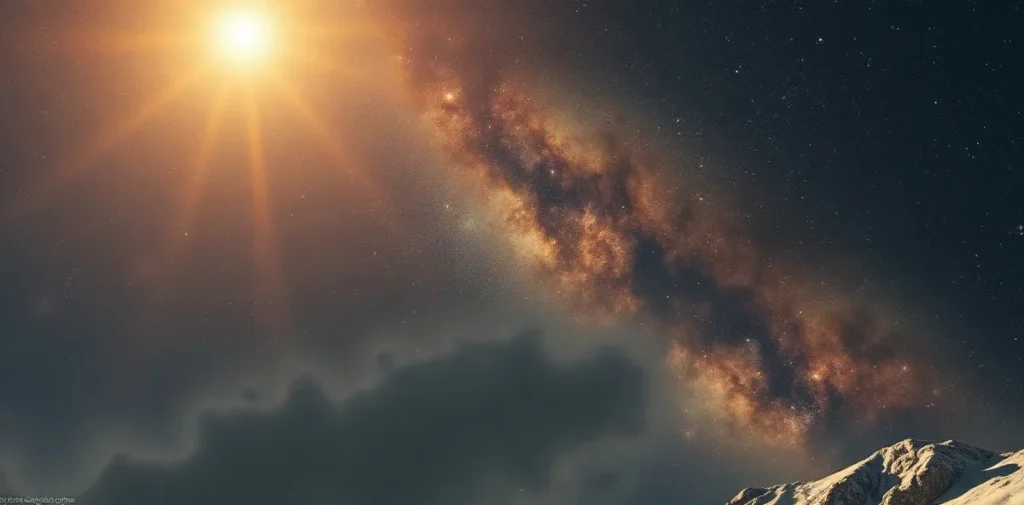
Galaxies form and evolve mainly through gravitational processes, mergers with each other, and active star formation, all of which together shape their current structure and dynamics. Modern observations, including data from the James Webb Space Telescope, allow detailed study of these processes at different stages of galaxy life.
What processes underlie galaxy formation?
Galaxy formation begins with the collapse of dense clouds of cold gas and dark matter in the early Universe. Gravity pulls matter inward, creating protogalaxies that gradually develop into galaxies of various morphologies.
Main stages of formation
- Collapse of dark matter and gas into dense clumps (protogalaxies)
- Onset of star formation within dense gas clouds
- Formation of spiral or elliptical structures depending on angular momentum and environment
- Influence of mergers and interactions on morphology
Contemporary models, such as the IllustrisTNG cosmological simulations, confirm that these stages form the foundation of galaxy formation. For example, 70% of spiral galaxies observed in the local Universe have shapes defined by the angular momentum of gas accumulated during early epochs.
How do interactions and mergers affect galaxy evolution?
Galaxy interactions are a key factor in their evolution. Mergers can cause significant structural changes, trigger intense star formation, and even transform morphology.
Types of interactions
- Minor mergers — absorption of dwarf galaxies
- Major mergers — collisions of galaxies with comparable masses
- Flybys and tidal interactions without merging
For instance, the merger between the Milky Way and the Andromeda galaxy is expected in about 4 billion years, resulting in the formation of a new elliptical galaxy. Studies using the MUSE spectrograph at the European Southern Observatory show that major mergers can increase the star formation rate by up to 100 times compared to isolated galaxies.
What role does star formation play in galaxy formation?
Star formation—the process of converting gas clouds into new stars—affects the chemical composition and dynamics of galaxies.
Mechanisms of star formation
- Collapse of molecular clouds under gravity
- Effects of supernovae and intense radiation stimulating or suppressing star formation
- The role of turbulence and magnetic fields in gas distribution
According to a review published in Astronomy & Astrophysics (2026), the average star formation rate in a typical spiral galaxy is about 1–3 solar masses per year, while in active star-forming regions it can exceed 50 solar masses per year.
What observational methods are used to study galaxies?
Modern astronomical instruments allow the study of galaxies across different electromagnetic spectrum ranges, revealing their structure, composition, and dynamics.
Main tools and methods
- Optical telescopes (e.g., Very Large Telescope, ESO)
- Infrared telescopes (e.g., James Webb Space Telescope)
- Radio telescopes (e.g., ALMA — Atacama Large Millimeter/submillimeter Array)
- Spectroscopic techniques to analyze chemical composition and velocity
| Telescope | Range | Resolution | Main goals |
|---|---|---|---|
| James Webb (JWST) | Infrared | 0.1 arcseconds | Studying early galaxies and star formation |
| Very Large Telescope (VLT) | Optical/Near-IR | 0.01 arcseconds | Examining galaxy structure and chemistry |
| ALMA | Radio range | 0.01 arcseconds | Observing cold gas and molecules |
How do galaxies change over time?
Galaxies evolve from young, gas-rich protogalaxies into mature systems with diverse morphologies and stellar populations.
Evolution phases
- Early phase: active star formation and mass accumulation
- Middle phase: structural stabilization, formation of spiral or elliptical shapes
- Late phase: decline in star formation, aging of stars
According to a review in the Astrophysical Journal (2026), most galaxies in the local Universe are in late evolutionary stages, with reduced star formation activity and an increasing fraction of old stars. However, periodic mergers can reignite their activity.
- 70% of spiral galaxies with defined structure in the local Universe
- 4 billion years until the expected Milky Way-Andromeda merger
- 1–3 solar masses per year — average star formation rate in spiral galaxies
Frequently Asked Questions
Why do galaxies have different shapes?
What is dark matter and why is it important for galaxies?
How long does star formation last in a galaxy?
Can a galaxy stop forming stars?
Key Takeaways
- Galaxies form from the collapse of gas and dark matter into protogalaxies.
- Mergers and interactions are primary drivers of galaxy evolution and morphology.
- Star formation shapes the chemical and dynamic makeup of galaxies.
- Modern telescopes, including JWST and VLT, provide crucial data on galaxy structure and development.
- Most galaxies in the local Universe are in late evolutionary stages with reduced activity.
Understanding galaxy formation and evolution is a fundamental challenge in modern astrophysics, enabling us to uncover the Universe’s history and predict its future. Thanks to current observations and simulations, we are approaching a comprehensive picture of these complex processes.