Updated: September 28, 2026
Introduction: Why Light Pollution Hinders Planetary Observation
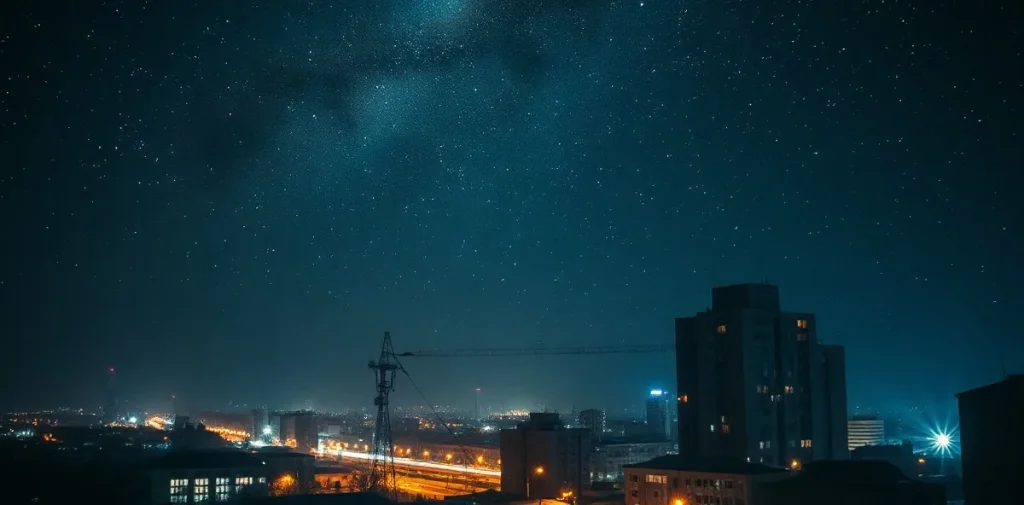
Light pollution is artificial lighting that obstructs the view of the night sky, including planets. It reduces contrast and the visibility of faint objects, significantly affecting both amateur astronomers and professional observatories. According to the Bortle scale, which measures light pollution levels, most urban areas exceed level 5, where planetary observation becomes extremely difficult.
For quality observations, darkness of at least 21.7 magnitude per square arcminute is required, which is achieved at distances over 50 kilometers from major cities.
Main Sources of Light Pollution
Artificial lighting—street lamps, advertising billboards, building illumination—creates a background that «washes out» the sky. This effect is especially noticeable in large metropolitan areas, where the total power of outdoor lighting reaches tens of megawatts.
Types of Sources
- High-pressure discharge lamps (e.g., sodium lamps with power from 70 to 400 W)
- LED streetlights with a cool spectrum (around 4000K and above)
- LED advertising panels with brightness over 1000 cd/m²
The transition to lamps with warm spectra and the use of directional light technologies help reduce pollution.
How Light Pollution Worsens Planetary Observation
Unlike stars, planets are not point sources of light, so they appear as low-contrast objects against a washed-out sky. Light pollution increases background brightness, reducing the discernibility of details on the surfaces of planets like Mars and Jupiter.
Indicators of Observation Degradation
This complicates detailed studies of atmospheric phenomena and planetary rings, as well as the observation of faint satellites.
Methods of Protection Against Light Pollution
To minimize the impact of light pollution, astronomers employ several practical approaches.
Choosing Observation Sites
- Remote astronomical observatories, for example, the Paranal Observatory in Chile, located at 2635 m altitude and more than 100 km from the nearest cities
- Protected dark-sky areas included in the international Dark Sky network, such as Great Basin National Park in the USA
Using Specialized Equipment
- Optical narrowband filters, such as the UHC filter, which blocks light from street lamps
- Dark telescope shields that reduce scattered light
- Digital image processing to enhance contrast
| Method | Light Pollution Reduction, % | Cost, ₽ | Applicability |
|---|---|---|---|
| Travel to a dark zone (e.g., Dark Sky park) | 90 | from 5000 (transport and accommodation) | For all levels of astronomers |
| UHC filter for telescope | about 60 | from 2500 to 15000 | Amateurs and professionals |
| Dark hoods and baffles | 30-50 | from 1000 | For stationary observations |
Technical Innovations and Legislative Measures
Modern technologies and regulations play a key role in combating light pollution.
Technical Solutions
- Dimmable lamps with adjustable spectra, such as Philips LED lamps with a color temperature of 2700K
- Automatic lighting shutdown systems during nighttime
Legislation
- In Russia, GOST R 54107-2010 regulates light pollution in populated areas
- International recommendations from the International Astronomical Union (IAU) on controlling artificial lighting
These measures help reduce the negative impact on astronomical observations and the environment.
Recommendations for Amateur Astronomers
To optimize planetary observations, it is necessary to combine the right conditions with proper equipment.
Practical Tips
- Choose locations with a light pollution level below 3 on the Bortle scale
- Use UHC or CLS filters to enhance contrast
- Plan observations during new moon phases and minimal cloud cover
These steps significantly improve observation quality even in suburban settings.
Frequently Asked Questions
What is the Bortle scale and how does it affect the choice of observation site?
Is it possible to completely eliminate light pollution?
Which filters are best for observing planets?
How does light pollution affect professional observatories?
Key Takeaways
- Light pollution significantly reduces contrast and quality of planetary observations.
- The Bortle scale helps assess and select locations with minimal lighting.
- Using filters and dark zones are the most effective protection methods.
- Technical innovations and legislation are gradually mitigating the issue.
- Amateur astronomers can greatly enhance observations by following practical advice.
Conclusion
Light pollution remains a serious obstacle to studying planets and other celestial objects. However, modern methods and technologies allow its impact to be minimized. Choosing the right site, applying specialized filters, and following lighting guidelines enable astronomers in 2026 to obtain quality observations even amid growing urbanization. Preserving dark skies is a vital challenge for both science and the environment.
Sources
- innoter.com — «Environmental Light Pollution»
- Light Map — «Light Pollution Map | Bortle Scale | Sky Without Light Pollution»
- Ecocosm — «Light Pollution: Searching for the Milky Way»
- siriusmag.ru — «Noctalgia: What Is Light Pollution and Who It Affects»
- naukatv.ru — «How Light Pollution Affects Mental Health»