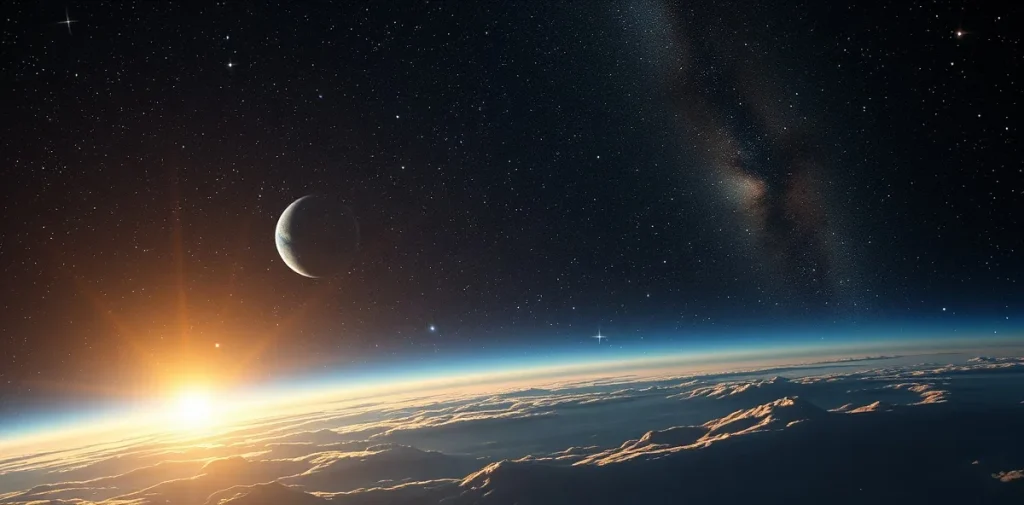
Space contains planets, stars, galaxies, gas and dust, which are studied using telescopes, spacecraft and observations across different ranges of radiation.
Each method reveals a different aspect of the universe: telescopes collect light from distant objects, while spacecraft explore space and celestial bodies firsthand. These facts about space will help you understand which objects surround Earth and how scientists learn about them.
| Object | What it is | Observable feature |
|---|---|---|
| Star | Celestial body | Emits light |
| Planet | Body that orbits a star | Visible by reflected light |
| Pulsar | Rotating neutron star | Periodic pulses of radiation |
| Galaxy | System of stars and interstellar matter | Studied through its light and distribution |
| Constellation | Region of the celestial sphere | Pattern of stars in the sky |
What do we mean by space and celestial objects?
Space is the expanse where celestial bodies are found and astronomical phenomena occur. Celestial objects include the Sun, Moon, stars, planets, pulsars and galaxies: they differ in structure and scale, but astronomy studies them all.
A constellation is a region of the celestial sphere defined by a pattern of stars. It provides a way to divide and describe the sky: stars that appear close together in such a pattern are not necessarily connected in space.
Natural and artificial objects
Celestial objects are also classified by their origin. Natural objects arise without human involvement, while artificial ones are made by people. Planets and stars, for example, are natural; human-made objects in space are artificial.
How do stars, planets, pulsars and galaxies differ?
Objects and their observable features
Stars emit their own light, planets orbit stars, pulsars are identified by recurring pulses of radiation, and galaxies are vast collections of stars and interstellar matter. The Sun, therefore, is a star, while Earth and other planets are not: they orbit stars.
- The Sun is a star and a source of light, while Earth is a planet that orbits a star.
- The Moon is Earth’s natural satellite. Its visible shape changes as it moves around the planet: an observer sees different portions of its sunlit surface.
- A pulsar is a rotating neutron star. It is observed through periodic pulses of radiation that reach Earth.
- A galaxy contains stars and interstellar matter; telescopes are used to study its scale and distribution.
A telescope helps researchers study galaxies by collecting light from distant objects and revealing how they are distributed across the sky. Different observing methods are used to study space: the James Webb Space Telescope (JWST) collects light, while LIGO, Virgo and KAGRA detect gravitational waves. Comparing these observations helps researchers study objects and phenomena that cannot be described by their visible light alone.
How do astronomers study space?
Astronomers study space by collecting and analyzing different signals: light from distant objects, gravitational waves and information about the distribution of galaxies. These methods complement one another, each helping to explore the universe from a different angle.
Light and gravitational waves
Optical telescopes collect light from stars and galaxies, which astronomers analyze to study distant objects. The James Webb Space Telescope (JWST) observes the universe from space, where it can receive light that does not pass through Earth’s atmosphere.
- Light: Optical telescopes collect radiation from celestial objects for further analysis; JWST observes from space.
- Gravitational waves: LIGO, Virgo and KAGRA detect ripples in spacetime—a different kind of signal, not light.
Gravitational waves give astronomers another way to study cosmic events: they are detected not as an image or light spectrum, but as changes passing through space.
The distribution of galaxies
Mapping galaxies shows where they are located and how they form the large-scale structure of the universe. By comparing such maps with observations of light and detections of gravitational waves, astronomers gain different kinds of information about space rather than relying on just one method of observation.
How did people begin exploring space?
People began exploring space with the first crewed flights, then expanded their efforts to include satellites, research spacecraft and observational instruments. Space exploration began more than six decades ago; Yuri Gagarin’s flight was a turning point.
On April 12, 1961, Yuri Gagarin became the first person to orbit Earth. His flight opened a new chapter in space exploration: people could not only observe the sky from Earth, but also travel beyond it.
Flights and observations
Space exploration is about more than human spaceflight. The James Webb Space Telescope studies distant objects through their light, while LIGO, Virgo and KAGRA detect gravitational waves; telescopes also help map galaxies and the large-scale structure of the universe. These instruments make it possible to study space in different ways, even when no person is near the object being investigated.
Private companies SpaceX and Blue Origin are involved in space projects today. Their participation shows that space exploration involves both government programs and companies developing their own space projects.
Why can’t one observing method tell us everything?
One observing method cannot tell us everything because each instrument detects a different type of cosmic signal and answers different questions. Telescopes, including the James Webb Space Telescope, receive light, while LIGO, Virgo and KAGRA are designed to detect gravitational waves: these signals are not interchangeable.
An object’s brightness alone does not reveal either its distance or its size. Visibility depends on the radiation it emits and the conditions in which it is observed. A dim object, therefore, is not necessarily small or nearby, and a bright one is not necessarily large or nearby. A constellation should not be confused with an individual celestial body: it is a designated region of the sky, not a single star or galaxy.
Building the bigger picture
Astronomers compare different types of observations to study space from several angles. This picture includes light, gravitational signals, particles and the distribution of galaxies: telescopes help study radiation and map galaxies, while gravitational-wave detectors capture signals that cannot be accessed through ordinary observations of light.
How can you start observing space for yourself?
You can start observing space with the naked eye: first find the Moon, the Sun or a bright planet in the sky, and identify exactly which object you are seeing. Distinguish the object itself from its designated position on a sky map: a constellation marks a region of the sky, not a particular star or planet.
Star charts and planetariums help connect constellation names with what can be seen above the horizon. Compare the chart with the real sky and note where the region you want to find is located; this makes it easier to identify the object you are looking at before examining it more closely.
Telescopes and safe observing
A telescope lets you see celestial objects in greater detail, but it does not explain what is in the field of view. For a first look, it is more useful to identify the object on a sky chart, then point the instrument at it. The Sun can only be observed with protective equipment designed specifically for solar viewing: never look at it through an ordinary telescope.
Frequently asked questions
What counts as a celestial object?
How are gravitational waves detected?
What is a pulsar?
When did a person first orbit Earth?
Key takeaways
- The Sun is a star; the Moon is Earth’s natural satellite.
- Pulsars are identified by periodic pulses of radiation.
- JWST observes light, while LIGO, Virgo and KAGRA detect gravitational waves.
- A constellation is a region of the sky, not a physical group of connected objects.
- On April 12, 1961, Yuri Gagarin became the first person to orbit Earth.
Sources
- starwalk.space — “What Is Space? Definition, What It Looks Like and What It Is Made Of”
- foxford.ru — “Space. Celestial Bodies. Stars and Constellations”
- spacegid.com — “Astronomy: What Kind of Science Is It and What Does It Study?”
- Big Novosibirsk Planetarium — “Cosmic Objects”
- United Nations — “Outer Space”