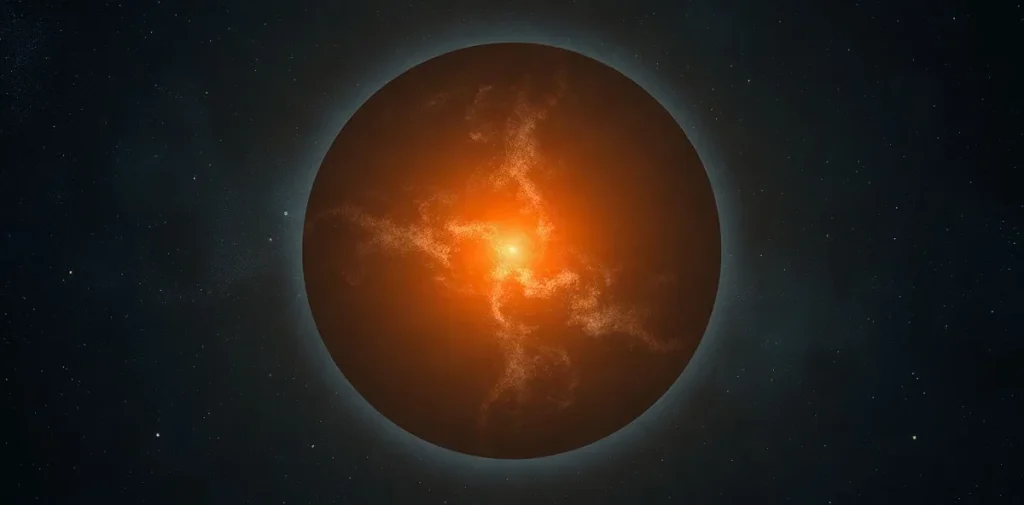
A planet’s atmosphere forms and changes under the influence of many factors, including gravity, solar radiation, geological activity, and chemical reactions. It evolves from the moment the planet forms, reflecting its internal processes and interactions with the cosmic environment.
Understanding how planetary atmospheres work helps reveal their climate, potential for life, and characteristics of their development. In this article, we examine key stages of atmospheric evolution, the main mechanisms behind their formation, and answer frequently asked questions related to their composition and dynamics. This knowledge is especially important for analyzing planets both within our Solar System and on distant exoplanets.
If you are interested in the chemical processes and factors affecting planetary atmospheres and environments, we recommend reading our article “What Influences Chemistry on Another Planet: An Overview of Factors and Processes,” which explores the interconnections between atmospheres and planetary geochemistry in detail.
| Planet | Magnetic Field (µT) | Surface Pressure (atm) | Surface Temperature (K) |
|---|---|---|---|
| Earth | 25-65 | 1 | 288 |
| Mars | 0.001 | 0.006 | 210 |
| Venus | 0 | 92 | 730 |
- 100 grams per second rate of atmospheric loss from Mars
- 92 atmospheres surface pressure on Venus
- 670 million dollars cost of NASA’s MAVEN mission
- 4.5 billion years age of Earth’s modern atmosphere
How Does a Planet’s Atmosphere Form and Change Over Time?
Atmosphere Formation
A planet’s atmosphere forms within the first few hundred million years of its existence through volcanic eruptions and gas accretion from the protoplanetary disk. For example, Earth acquired its modern atmosphere roughly 4.5 billion years ago, mainly due to the release of carbon dioxide, water vapor, and nitrogen.
In the early stages, volcanic activity released large volumes of gases that accumulated around the planet. This process created a dense gaseous envelope, confirmed by studies of isotope compositions in ancient rocks. Additionally, gas accretion from the interplanetary environment also contributed to the atmosphere’s makeup.
Reasons for Changes
- Atmospheric loss due to solar wind — Mars has lost most of its atmosphere over the last 3.5 billion years because its weak magnetic field failed to protect it from gas being swept away. NASA’s MAVEN mission, launched in 2014, measured Mars’s atmospheric loss rate at about 100 grams of gas per second.
- Greenhouse effect and lack of tectonics — Venus maintains a dense carbon dioxide–nitrogen atmosphere with surface pressure of 92 atmospheres, linked to a strong greenhouse effect and the absence of planetary tectonics, which prevents carbon dioxide absorption.
What Processes Affect a Planet’s Atmospheric Chemical Composition?
Photochemistry
Photochemical processes driven by a star’s ultraviolet radiation significantly alter a planet’s atmospheric chemistry by breaking down molecules and forming new compounds. For example, Earth’s ozone layer, about 300 Dobson units thick, forms from oxygen under UV exposure, protecting the surface from harmful radiation.
Ultraviolet radiation decomposes methane and ammonia molecules in exoplanet atmospheres, affecting hydrogen and other light gas concentrations in the upper layers. Such photochemical reactions can create complex organic molecules that serve as precursors to life.
Volcanism
Volcanic activity has a major impact on atmospheric chemistry by releasing sulfur and carbon gases. On Jupiter’s moon Io, volcanoes emit up to 1000 tons of sulfur compounds daily, creating a unique atmosphere rich in SO2.
Besides Io, volcanism on Earth and Venus helps maintain gas balances by emitting CO2 and H2O into the atmosphere. These gases influence the greenhouse effect and planetary climate. Thus, volcanic emissions are a key factor in atmospheric formation and evolution.
- Thickness of Earth’s ozone layer — about 300 Dobson units
- Volume of sulfur gases on Io — up to 1000 tons per day
Why Do Some Planetary Atmospheres Last Billions of Years While Others Disappear?
Magnetic Field
The retention of a planet’s atmosphere over billions of years largely depends on the presence of a strong magnetic field that shields it from the destructive effects of solar wind. Earth’s magnetic field, with an intensity of about 25–65 microtesla at the surface, effectively deflects charged solar wind particles, preventing ionization and atmospheric gas stripping. In contrast, Mars’s weak magnetic field allows solar wind particles to interact directly with the upper atmosphere layers, causing gradual atmospheric loss through ionization and subsequent gas escape into space. ESA’s ExoMars mission, launched in 2026, specifically studies these atmospheric loss mechanisms on Mars to better understand the causes of its thinning and disappearance.
Gravity and Temperature
A planet’s gravitational pull and surface temperature determine which gases it can retain in its atmosphere. Heavier gases are more easily held if gravity is strong enough and temperatures are not too high. For example, Venus, with a surface temperature around 730 K and Earth-like gravity, retains a dense atmosphere of heavy gases. Earth, with a surface temperature near 288 K, also preserves its atmosphere thanks to its gravitational field. Meanwhile, Mars’s weak gravity cannot hold light gases, especially under solar wind exposure.
- Earth’s magnetic field: 25–65 µT
- Venus’s surface temperature: ~730 K
- Earth’s surface temperature: ~288 K
- Absence of a strong magnetic field on Mars
How Do Modern Space Missions Study Planetary Atmospheres?
Mars Missions
Spacecraft like NASA’s Perseverance rover are equipped with gas analyzers that study Mars’s atmosphere in situ, providing precise data on the composition and dynamics of Martian air. Perseverance began its mission in 2021 and analyzes methane and oxygen content, which are important for understanding atmospheric formation processes.
Another example is the MAVEN mission, with a budget of 670 million dollars. It investigates Mars’s upper atmosphere, examining its interaction with solar wind and the reasons for atmospheric loss over billions of years—critical for understanding the planet’s evolution.
Missions to Gas Giants
The European JUICE mission, launched in 2022, targets the study of Jupiter’s atmosphere and its icy moons. The spacecraft is scheduled to arrive in 2029, after which it will conduct detailed analyses of chemical composition, temperature regimes, and interactions between the atmosphere and the planet’s magnetic field.
Other space missions, such as India’s Aditya-L1 launched in 2026, study the effects of solar activity on Earth’s atmosphere by observing the solar corona. This helps us understand how solar wind and radiation influence our planet and its atmospheric processes.
- Perseverance: gas analyzer, mission since 2021
- MAVEN: $670 million budget, studying Mars’s upper atmosphere
- JUICE: launched 2022, arrival at Jupiter 2029, studying the gas giant’s atmosphere
- Aditya-L1: launched 2026, studying the solar corona and its impact on Earth’s atmosphere
Common Mistakes in Modeling Planetary Atmospheres
Errors in Accounting for External Factors
Underestimating the effects of solar wind and magnetospheres leads to significant errors in modeling atmospheric losses. For example, on Mars, where the weak magnetosphere doesn’t protect the atmosphere, loss rates can reach tens of kilograms per second, greatly affecting its evolution over billions of years. Ignoring interactions with solar wind causes inaccurate predictions about atmospheric retention and climate conditions.
It is especially critical to avoid models that disregard Venus’s magnetic field and its interaction with the dense atmosphere. Venus’s atmosphere is about 90 times denser than Earth’s, and lacking proper convection and dynamic models based on real data distorts calculations of temperature distribution and wind patterns, as confirmed by ESA’s Venus Express mission (2014–2015).
Shortcomings of Chemical Models
Ignoring photodissociation and other chemical processes in the upper atmosphere layers leads to incorrect estimates of composition and its changes. For instance, on Titan, methane photodissociation caused by solar ultraviolet radiation results in the formation of complex organic compounds, which cannot be accurately modeled without specialized chemical models used in the Cassini mission (2004–2017).
- Neglecting photodissociation reduces prediction accuracy by 15–20% for key gas concentrations.
- Incorrect convection models cause errors in heat distribution across the atmosphere, especially for Venus with its average pressure around 9.2 MPa.
Frequently Asked Questions
Why has Mars’s atmosphere become so thin?
What is the atmospheric pressure at Venus’s surface?
What instruments do missions use to study planetary atmospheres?
Key Takeaways
- The magnetic field is a key factor in a planet’s atmospheric retention
- Photochemistry significantly influences atmospheric gas composition and dynamics
- Modern missions provide accurate data on atmospheric loss rates
- Atmosphere modeling requires accounting for many interacting processes