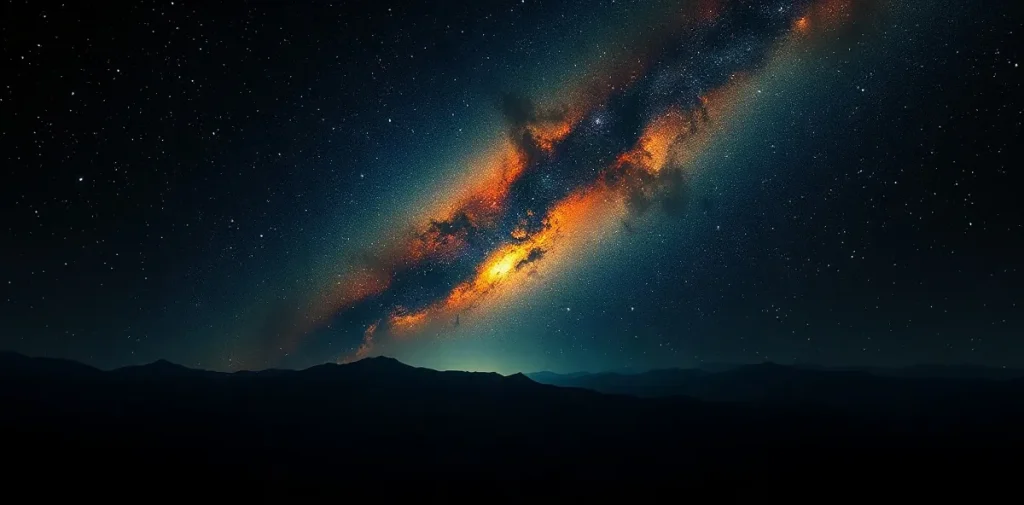
Stars are hot balls of gas that emit their own light, while galaxies are vast systems in which stars are held together by gravity along with gas, dust, and other objects. Galaxies vary in size and shape, and stars are born, change, and eventually reach the end of their lives.
This article answers questions about stars and galaxies: how these objects work, how they differ, and how they are connected. For a broader overview, see our article “Stars and Galaxies: How the Universe’s Key Objects Work and Relate to One Another.”
| Object or method | What it is | What it helps us learn |
|---|---|---|
| Star | Self-luminous object | Temperature and composition from light |
| Star cluster | Group of stars | Bound groups within galaxies |
| Galaxy | System of stars, gas, dust, and dark matter | The structure and composition of a large cosmic system |
| Optical telescope | Instrument for visible light | Images of stars and galaxies |
| Radio telescope | Instrument for radio waves | Cold gas and radio-emitting regions |
- about 300,000 km/s the speed of light in a vacuum
- about 8 minutes 20 seconds the time sunlight takes to reach Earth
- approximately 3.26 light-years the length of one parsec
- more than four years the time light takes to travel from Proxima Centauri to Earth
What is a star, and why does it shine?
A star is a hot ball of gas that emits its own light: in the Sun’s core, nuclear fusion converts hydrogen into helium and releases energy that reaches us as light and heat. The Sun is the closest star to Earth, and its light takes about 8 minutes 20 seconds to reach our planet.
What starlight can tell us
Stars are made mostly of hydrogen and helium. Their radiation helps us determine their surface temperature and chemical composition: different substances leave distinctive lines in a spectrum, like fingerprints.
A star’s color is related to its surface temperature: blue stars are hotter than red ones. So its hue is more than a visual feature—it offers clues about the physical properties of a distant star.
How does starlight reveal distance and the past?
Starlight tells us both how far away stars are and about their past: because it travels through a vacuum at about 300,000 km/s, we see distant objects as they were when their light set out on its journey. That is why sunlight takes about 8 minutes 20 seconds to reach Earth, while light from Proxima Centauri, the star closest to the Sun, takes more than four years to reach an observer.
How distances to stars are measured
For nearby stars, astronomers use parallax: they compare a star’s apparent position against the background of more distant objects, observing it from different points in Earth’s orbit. The larger the shift, the closer the star; this method links distance to a measurable angle.
A parsec and a light-year are units of distance, not time. One parsec is approximately 3.26 light-years: a light-year is the distance light travels in a year, not the length of time it takes to travel to a star.
What is a galaxy made of?
A galaxy consists of stars, interstellar gas and dust, as well as dark matter, which is part of its overall structure. The Milky Way is a spiral galaxy; the Solar System lies in one of its spiral arms.
Andromeda is the nearest large spiral galaxy to the Milky Way. Its light comes from beyond our galaxy and allows us to study the structure of another star system of this type.
At the center of the Milky Way is the compact radio source Sagittarius A*, associated with a supermassive black hole. So a galaxy includes more than just spiral arms filled with gas and dust: its central region contains an object associated with one of the most powerful forms of gravity.
How do telescopes study stars and galaxies?
Telescopes study stars and galaxies by collecting radiation across different bands and analyzing its spectrum: optical instruments detect visible light, infrared telescopes detect longer wavelengths, and radio telescopes detect radio waves. For example, the Hubble Space Telescope observes galaxies and star clusters in visible light, while the James Webb Space Telescope operates primarily in the infrared.
What different wavelengths of light reveal
- Visible light: Optical telescopes collect it to produce images of galaxies and star clusters; Hubble is an example of such a space telescope.
- Infrared radiation: The James Webb Space Telescope studies objects whose light is strongly shifted toward infrared wavelengths.
- Radio waves: Radio telescopes detect these, rather than visible light. Such observations help scientists study cold gas and active regions of galaxies.
Spectroscopy complements images by analyzing light: an instrument splits it into a spectrum, where the lines provide clues about an object’s chemical composition and motion. So telescopes do more than record where a star or galaxy is: observations across different bands and spectral lines let us investigate the properties and processes of these objects.
When does observation fail to provide the full answer?
What can distort observations
Observations do not provide the full answer when an object’s radiation is weakened or does not contain all the information about it: a telescope records the light that reaches the observer, not a distant galaxy’s immediate “now.” That is why an image shows its past state, not the object’s entire history.
Interstellar dust absorbs and scatters visible light, hiding regions of space; infrared observations can peer through some of this dust, but they do not remove the limitations of observation. A star’s apparent brightness also does not, by itself, tell us its intrinsic luminosity: it depends on the star’s distance, too, so comparisons based only on brightness can be misleading.
- Visible light: Dust can absorb or scatter it, making a hidden region difficult to distinguish.
- Infrared radiation: It helps reveal some regions obscured by dust, but does not reveal every property of an object.
- Gravitational effects: Dark matter does not emit light; its presence is inferred from its effect on visible matter and light.
How do a star, a star cluster, and a galaxy differ?
A star is a single self-luminous object, a star cluster is a group of stars, and a galaxy is a much larger system that includes stars, gas, dust, and dark matter. The closest star to Earth is the Sun: it shines on its own rather than reflecting the light of another object.
- Star: An individual luminous celestial body; the Sun is the closest example to us.
- Star cluster: A group of stars bound by a shared origin or by gravity. Globular clusters are part of galaxies.
- Galaxy: A large system of stars, gas, dust, and dark matter. It can contain star clusters.
These terms differ in scale and composition: an individual star can be part of a cluster, and a cluster can be part of a galaxy. For broader context, read our article “Stars and Galaxies: How the Universe’s Key Objects Work and Relate to One Another.”
Frequently asked questions
Why do we see stars as they were in the past?
What is a light-year?
Can dark matter be seen through a telescope?
How do scientists determine the composition of a distant star?
Key takeaways
- The Sun is a star, and its light takes about 8 minutes 20 seconds to reach Earth.
- A light-year measures distance; one parsec is approximately 3.26 light-years.
- A galaxy contains stars, gas, dust, and dark matter.
- Hubble observes visible light, while the James Webb Space Telescope operates primarily in the infrared.
