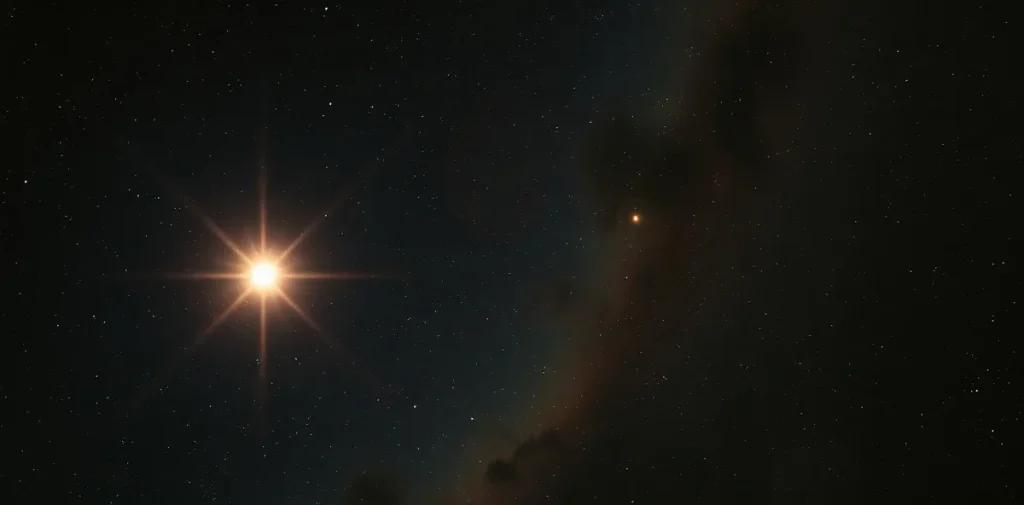
“Kosmostars” and “little stars” before your eyes are not celestial objects, but flashes or spots in your field of vision. If they appear suddenly, recur, or are accompanied by worsening vision, it is important not to delay a medical assessment.
These visual effects can look like sparks, dots, or flickering lines. Their cause cannot be determined from a description alone: the circumstances in which they appear and any accompanying symptoms matter.
How can you tell a brief flash from a reason to seek help, and what should you look out for?
| Sign | Star in the sky | Spot or flash in your field of vision |
|---|---|---|
| Where it appears | In the sky | In your field of vision |
| What it is | A distant astronomical object | A visual phenomenon |
| Possible explanation | The great distance to the star | Possible causes include changes in the retina or vitreous body |
| What to check | The object’s position relative to other objects in the sky | Whether the effect appears when you are not looking at the sky |
- 225 г, 325 г, 450 г или 600 г Pack sizes for Kosmostars breakfast cereal
- 20 сентября по 17 октября 2021 года Kosmostars promotion period
Why do stars look like tiny points?
Stars look like tiny points because they are so far away that the naked eye cannot make out their disks.
Even the closest star to the Solar System, Proxima Centauri, is four light-years away. Starlight travels an enormous distance before reaching an observer, so a star cannot be seen as an extended, round object.
Why stars twinkle
Twinkling begins as light travels to Earth. The atmosphere consists of moving layers of air, and starlight passes through them before reaching the eye.
Changes in the atmosphere alter the path of the light, so a star’s brightness and position can appear unstable. This twinkling does not mean the star is pulsing or changing size: what changes is the way its light travels through the air.
“Little stars” in your field of vision are a different phenomenon. They may be associated with changes inside the eye, including a retinal tear or detachment; sudden flashes are worth discussing with an ophthalmologist.
How can you tell whether a little star is in the sky or in your field of vision?
You can distinguish a star from a flash in your eyes by shifting your gaze from the sky to an object on the ground: a star remains an object in the sky, while a visual effect may stay in your field of vision regardless of where you look.
Observing the sky
A star in the sky is visible when you look at a patch of sky. You can compare its position with other objects—for example, notice that a point of light is near a particular group of stars. Distant stars look like points, and their light twinkles as it passes through shifting layers of air.
- Star: visible against the sky, with its position comparable to that of other celestial objects.
- Flash or spot in your field of vision: perceived as a visual phenomenon, not as an object on the celestial sphere.
A phenomenon in your field of vision
A visual flash may look like a “little star,” but you cannot link it to other objects in the sky. Check whether it disappears when you shift your gaze from the sky to an object on the ground. If the effect remains in your field of vision, do not mistake it for twinkling in the sky.
The twinkling of a distant star and floaters or flashes before your eyes are different phenomena: the first is caused by light passing through the atmosphere, while the others arise in your vision. New or recurring flashes should not be attributed to stargazing; consult an ophthalmologist for an assessment.
When do flashes and floaters need attention?
Flashes and “floaters” need medical assessment when they appear in your field of vision rather than while you are observing the sky: a description of “little stars” alone is not enough to determine the cause.
Floaters may be associated with a retinal tear or detachment, as well as bleeding into the vitreous body—the transparent, gel-like substance inside the eye. Inflammation of the vitreous body or cornea can also cause visual disturbances.
Pay attention to where the spots or flashes appear. Stars in the sky twinkle because their light passes through moving layers of air; disturbances you notice in your own field of vision are a different reason for concern.
Do not try to determine the cause solely by how the “little stars” look: similar visual phenomena can accompany different conditions. If flashes or spots appear before your eyes, seek a medical assessment.
How can you tell celestial stars from the name Kosmostars?
Kosmostars is the name of a breakfast cereal, not an astronomical object; stars in the sky and “little stars” in your field of vision are different phenomena.
Kosmostars comes in packs weighing 225 g, 325 g, 450 g, and 600 g. The product description says the cereal is intended for “little astronauts” and should provide energy and positivity in the morning.
How to check which “little stars” you mean
- Kosmostars on a package is a breakfast cereal. Its promotional campaign ran from 20 September to 17 October 2021; those dates refer to the promotion, not to observations of stars.
- Twinkling in the night sky is light from a distant star passing through shifting layers of air near Earth. This makes the light appear to change.
- Flashes or “little stars” before your eyes are a visual phenomenon unrelated to a cereal package or celestial light. These symptoms may be associated with problems involving the retina or vitreous body; sudden flashes are a reason to consult an ophthalmologist.
What should you choose: stargazing or an eye check?
Choose stargazing if the points are visible in the sky against the dark; if flashes occur before your eyes regardless of the sky, you need an eye check.
- In the sky: points of light look like distant objects and twinkle against the darkness. This can be explained by starlight passing through shifting layers of air.
- In your field of vision: spots or flashes appear regardless of whether you are looking at the sky. Do not consider them an astronomical phenomenon: visual disturbances can have various causes.
The deciding factor is where the effect appears: in the space above you or before your eyes. If you cannot confidently tell by observing it, do not draw conclusions about the cause from how the “little stars” look alone.
You cannot identify the specific cause of visual disturbances yourself based on a single symptom. Floaters and flashes may be associated, for example, with changes in the retina or vitreous body; determining the cause requires an eye examination by a specialist.
Frequently asked questions
Why do stars look so small?
Why do stars twinkle?
What might “little stars” in your field of vision mean?
Is Kosmostars the name of stars?
Key takeaways
- Distant stars appear as points; their light twinkles as it passes through moving air.
- Proxima Centauri is four light-years from the Solar System.
- Flashes in your field of vision may have causes involving the retina, vitreous body, or cornea.
- Kosmostars is the name of a breakfast cereal, not an astronomical object.
Sources
- postnews.ru — “Why Do Stars Twinkle, and Why Do We See It Only Hundreds of Years Later?”
- starwalk.space — “The Main Differences Between Stars and Planets: How They Differ”
- glazalazer.ru — “Floaters Before the Eyes as a Symptom of Disease”
- klinikasoyuz.ru — “Spider Veins: Causes, Prevention, and Why They Are Dangerous. Treatment of Spider Veins in Moscow”
- visus-novus.ru — “Are Floating Floaters and Flashes Dangerous?”