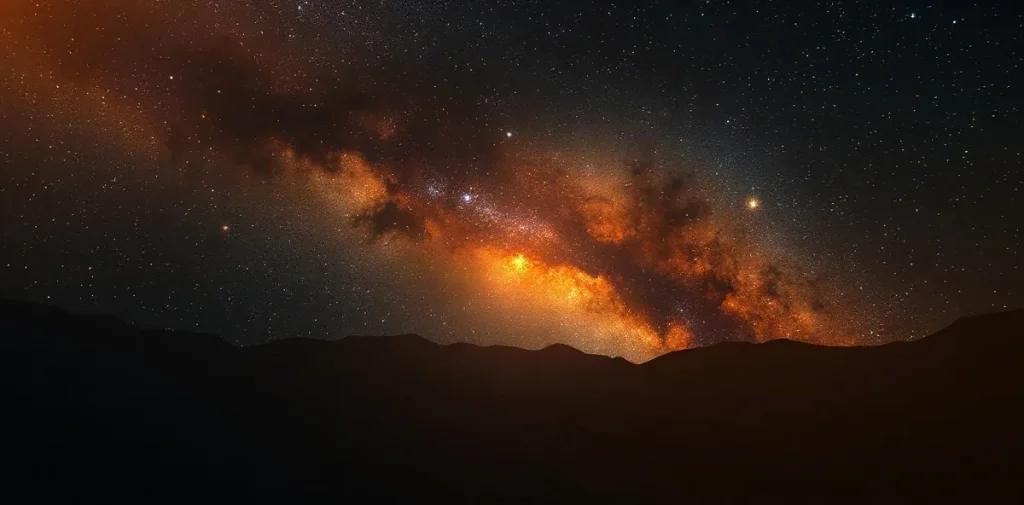
Stars are massive luminous objects, while galaxies are vast systems that gravity binds together from stars, gas, and dust. Stars are born, live, and change within galaxies, and their motion and interactions with their surroundings help shape these systems.
To understand how stars and galaxies work and connect, it is important to consider both individual stars and their cosmic surroundings. Our overview, “Types of Stars and Galaxies: Classification, Features, and Examples,” explains how these objects are distinguished; for more on the scale of the universe, see “A Universe of Galaxies and Stars: From Starlight to the Cosmic Web.”
For how we learn about distant systems and where our home lies among them, read “Galaxies and Stars in Space: How Astronomers Measure Distance and Properties” and “The Solar System Among Stars and Galaxies: Our Place in the Milky Way.”
| Object or feature | Method | What can be studied |
|---|---|---|
| Nearby star | Parallax | Distance |
| Starlight | Spectral analysis | Composition, temperature, motion |
| Galaxy | Image and spectrum | Shape and emission properties |
| Constellation | Star chart | Visible pattern, not physical proximity |
- 1 The Sun is the star at the center of the Solar System
- 3 commonly distinguished morphological galaxy types: spiral, elliptical, and irregular
- 2 main components of stellar spectral analysis: observed light and its distribution by wavelength
What is a star, and why does it shine?
A star is a massive ball of hot plasma that shines because nuclear fusion in its interior releases energy. The Sun is a main-sequence star: hydrogen is converted into helium in its core, and the energy released gradually travels to the surface and escapes into space as radiation.
What supports a star and determines its color
A star’s structure is determined by the balance between two forces: gravity pulls matter inward, while the pressure of hot gas and radiation counteracts the collapse. As long as this balance holds, the star maintains its shape; changes in its energy sources or pressure alter its state over time.
Surface color is related to temperature: bluish stars are hotter than yellow ones, while red stars are cooler. Their hues can be compared on a star chart—a clear way to gauge differences between stars without measuring instruments. For observing tips, telescope setup, and the first objects to look for, read our guide, “A Telescope for Stargazing: Choosing, Setting Up, and Finding Your First Objects.”
How are stars born, and how does their life end?
Stars are born when gravity compresses a cold cloud of gas and dust into a dense core. They end their lives in different ways depending on their mass: they shed their outer layers or explode, leaving behind a compact remnant. Compression raises the core’s temperature; once sustained nuclear fusion begins there, the young star enters the main sequence. The Sun is at this stage now.
How mass determines a star’s end
A star like the Sun evolves by shedding its outer layers, which disperse around the compact remnant. More massive stars can end their lives in a powerful explosion, after which a compact object also remains. These pathways show why a star’s mass matters not only at birth, but also in determining what remains after it.
A star’s radiation affects conditions in its surroundings, while those surroundings, in turn, are connected to the history of the star and its galaxy. Read more about this connection in “The Sun and Our Galaxy: How a Star Influences Life in the Milky Way.”
What is a galaxy made of, and what are its main types?
A galaxy is a gravitationally bound system of stars, interstellar gas, and dust. Its structure is held together by gravity, including the gravity associated with invisible dark matter. The Milky Way is a spiral galaxy, with a disk, a central region, and spiral arms; the Sun lies within the disk.
Main types of galaxies
- Spiral: Has a disk and spiral arms; the Milky Way belongs to this type.
- Elliptical: Has an elliptical shape and a structure without clearly defined spiral arms.
- Irregular: Lacks the clear, symmetrical shape characteristic of spiral and elliptical galaxies.
These types describe a galaxy’s visible shape and structure, but by themselves do not reveal its entire evolutionary history. Examples and classification features are collected in “Types of Stars and Galaxies: Classification, Features, and Examples,” while “A Universe of Galaxies and Stars: From Starlight to the Cosmic Web” explores the place of galaxies in the overall structure of the cosmos.
How do astronomers study stars and galaxies from a distance?
Astronomers study stars and galaxies through their light: visible light reveals an object’s brightness, color, and outline, while its spectrum helps estimate its chemical composition, temperature, and motion. In this way, observations turn radiation from a distant source into information about its properties.
How distance is measured
For nearby stars, astronomers use parallax: they compare a star’s apparent shift against more distant objects as Earth moves around the Sun. For distant galaxies, they use redshift and other distance-estimation methods; the reliability of a result depends on the available observations and the adopted model of the universe.
Parallax and redshift serve different purposes: the first method is based on an apparent change in a star’s position, while the second measures a change in the spectrum of light from a distant galaxy. For more on the capabilities and limitations of these measurements, see “Galaxies and Stars in Space: How Astronomers Measure Distance and Properties.”
How do stars in other galaxies differ from the Sun?
Stars in other galaxies are not a special type distinct from the Sun: like the Sun, they can vary in mass, age, temperature, and chemical composition. The Sun is one star, while a galaxy contains many stars, so it is wrong to assume that all its stars resemble the Sun.
The most reliable way to compare the Sun with other stars is by measurable properties, such as brightness and spectrum. Visible color provides only a limited impression of a star, and its apparent size in a photograph depends on the image scale; it is not a direct measurement of its physical size.
The Solar System and the Milky Way are not the same thing
The Solar System is a system in which objects orbit the Sun; the Milky Way is the galaxy of which the Sun is a part. For a comparison of their scales, see “The Solar System Among Stars and Galaxies: Our Place in the Milky Way.” For a comparison of stars and galaxies with the Sun and the Milky Way, see “Other Stars and Galaxies: How to Compare Them with the Sun and the Milky Way.”
When can observations and illustrative images be misleading?
Astronomical observations can be misleading if we mistake an image’s brightness for an object’s true luminosity, assigned colors for what the eye sees, or constellations for real groups of neighboring stars. An object’s apparent brightness is affected by its distance, and image processing changes how prominent details appear: a bright region in an image does not, by itself, prove that the object shines more intensely than a nearby one.
Colors in astronomical images can represent data collected beyond the visible-light range. This visualization helps reveal objects’ properties, but its palette does not necessarily correspond to what the human eye can distinguish. So when looking at an image of a star or galaxy, it is important to find out what data it shows and how those data were translated into color.
Constellations and physical structures
A constellation is a defined region of the celestial sphere with a pattern formed by stars, not necessarily a real group of stars located near one another in space. To avoid confusing constellations with physical structures, it helps to read a star chart alongside “Stars, Constellations, and Galaxies: How to Read a Star Chart.” For guidance on critically assessing scientific images, see “Videos About Stars and Galaxies: How to Watch Scientific Visualizations Critically.”
Frequently asked questions
How is a star different from a galaxy?
Why do stars look like tiny points?
How can we tell what a star is made of?
Are all the stars that look close together in the sky near one another?
Key takeaways
- The Sun is a main-sequence star within the disk of the Milky Way.
- A star’s spectrum provides information about its composition, temperature, and motion.
- Galaxies are classified by shape; the main types include spiral, elliptical, and irregular.
- A constellation forms a pattern in the sky and is not necessarily a physically connected group of stars.
