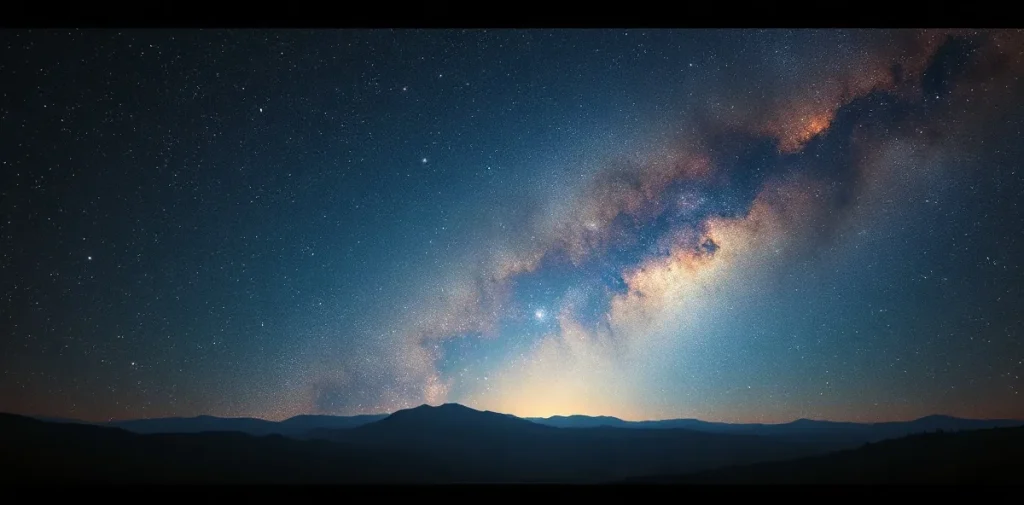
Stars twinkle because of turbulence in Earth’s atmosphere, while planets shine more steadily because their visible disks average out these fluctuations.
The atmosphere constantly changes the direction and refraction of light, so a star—a nearly point-like source—seems to grow brighter or dimmer and shift slightly. The air distorts a planet too, but its light comes from many points across its disk, so the fluctuations are partly smoothed out.
The difference is noticeable to the naked eye, although planets can twinkle too—especially low above the horizon, where their light passes through a thicker layer of atmosphere.
| Feature | Star | Planet |
|---|---|---|
| Typical appearance | Usually twinkles noticeably | Usually shines more steadily |
| Apparent size without magnification | Point source | Appears as a bright point, though it has a disk |
| Near the horizon | Twinkling intensifies | Can twinkle too |
| Identifying the object | Check its position among the stars | Check its position on a sky map |
Why do stars twinkle?
Stars twinkle because turbulent air changes the direction of their light and refracts it, altering the star’s apparent brightness and position.
The Sun’s heat warms Earth’s surface, causing warm air to rise and mix with cooler air. Air layers with different properties move around, and starlight passes through them before reaching the eye.
In a turbulent atmosphere, light follows a changing path: the air acts like an uneven lens. The eye perceives changes in refraction and direction as fluctuations in the star’s brightness and position.
Why planets twinkle too
A planet can twinkle too if it is low above the horizon: its light passes through more air. In these conditions, the atmosphere alters the apparent path of the light more strongly.
How does a planet’s twinkling differ from a star’s?
A planet twinkles less than a star because its visible disk consists of many areas whose fluctuations in light are partly smoothed out, whereas a star appears as a point to the naked eye.
The atmosphere affects the light from both objects. But a star is so distant that its apparent angular size is small: slight changes in air density noticeably alter the direction and brightness of this point source.
A planet is a closer neighbor of Earth, and its disk covers a noticeable area of the sky. Light from different parts passes through slightly different regions of the atmosphere; on average, their fluctuations cancel each other out, so the planet usually appears steadier.
The difference is related to apparent angular size, not to planets being outside the atmosphere: their light also passes through Earth’s air.
Which planets can you see without a telescope?
You can see five planets with the naked eye: Mercury, Venus, Mars, Jupiter, and Saturn.
The steady light of a bright point may suggest that it is a planet, but that alone does not confirm its identity. Check the point’s position against a current sky map: planets move relative to the stars.
Color is not a reliable guide either. A planet’s hue alone cannot distinguish it from a star—check its position on a map.
How can you tell a star from a planet with the naked eye?
The easiest way to tell a star from a planet with the naked eye is by its twinkling: a star’s point of light often changes brightness noticeably, while a planet usually shines more steadily.
Watch a bright object for several minutes and compare it with nearby stars at roughly the same height above the horizon. This makes it easier to notice twinkling and avoid confusing it with changes caused by observing conditions.
Then check the point’s position on a sky map: see whether it follows the expected path of the planets. A steady glow alone is not enough to identify an object with confidence.
To check again, note where the point is among the stars and look at the sky later. A planet gradually shifts relative to the stars.
Why does twinkling intensify near the horizon?
Stars twinkle more strongly near the horizon because their light passes through more air, and atmospheric fluctuations alter its path more noticeably.
A planet near the horizon can also appear to twinkle: the same long path through the atmosphere affects its light. That is why it is better to compare a star and a planet when both are higher above the horizon.
The flattened appearance of the Sun’s and Moon’s disks near the horizon, and the twinkling of stars, were observed in ancient times. These phenomena are related to atmospheric refraction—the change in the direction of light as it passes through the atmosphere.
When does the rule “planets don’t twinkle” not apply?
The rule “planets don’t twinkle” does not apply near the horizon: atmospheric turbulence can make a planet twinkle too, so a trembling point of light does not, by itself, prove that you are looking at a star.
Atmospheric turbulence changes over time. The same star can therefore appear to tremble noticeably at one moment and look steady at another; its apparent light depends not only on the object itself but also on the air between it and the observer.
If an object is low above the horizon, twinkles, or is seen through uneven air, check its position on a sky map. This is more reliable than identifying a planet or star by its appearance alone.
Why do planets and stars look like points?
Stars and planets look like points because their apparent angular sizes are too small for the unaided eye to resolve without optical magnification.
Each star is a separate, distant object, but its disk cannot be resolved with the naked eye. A planet has a visible disk, but it too usually appears as a bright point. Binoculars or a telescope help reveal details; to tell them apart initially, you can compare the object’s twinkling and position in the sky.
Twinkling and position offer clues, but they do not guarantee that you have identified the object correctly. To be sure, find it on a sky map and compare its position.
Sources
- bgkm.ru — “Why do stars twinkle?”