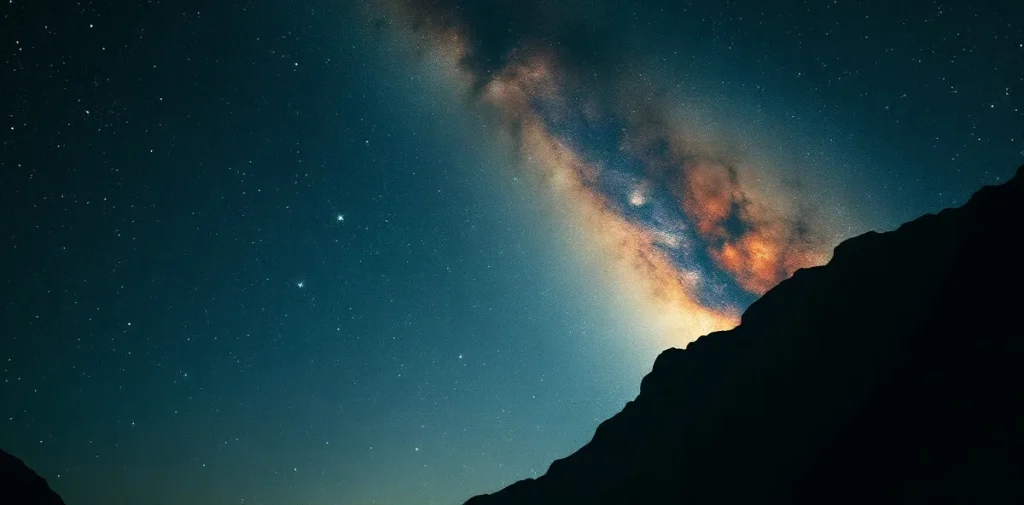
The Sun is connected to the Galaxy because it is one of its stars: together with the planets, it moves within the Milky Way and is subject to its gravity. The Galaxy influences the environment around the Solar System, while the Sun itself is only a tiny part of its vast stellar structure.
The connection between our star and the Galaxy is not just a matter of location in space; it also involves interactions across different scales, from the Sun’s motion to the structure of the Milky Way. For a broader picture, see our overview, “Stars and Galaxies: How the Universe’s Key Objects Are Structured and Connected.”
| Phenomenon | What moves or interacts | Scale |
|---|---|---|
| Earth’s orbit | Earth around the Sun | Solar System |
| Galactic motion | The Sun around the center of the Milky Way | Galaxy |
| Solar activity | Particles from the Sun and Earth’s magnetosphere | Near-Earth space |
Where is the Sun among the stars of the Milky Way?
The Sun is in the disk of the Milky Way, far from its center: the Sun is a star, and the Milky Way is the galaxy that contains the Sun, the planets, and many other stars. The Galactic center and the location of the Solar System are different regions.
The Milky Way is a disk-shaped galaxy, and the Sun belongs to that disk, not to the central region. It orbits the center of the entire Galaxy; this motion connects the Sun with the Milky Way’s other stars, even though they are in different parts of it.
How a star and a galaxy are connected
The Sun is an individual star, while the Milky Way is a large system containing many stars and planets. To learn more about how these objects are structured and connected, read our explainer, “Stars and Galaxies: How the Universe’s Key Objects Are Structured and Connected.”
How does the Sun move through the Galaxy?
The Sun moves through the Galaxy, orbiting the center of the Milky Way along with the other stars in its disk. This is not the same as Earth orbiting the Sun: the two motions have different centers and vastly different scales.
The Sun’s orbit lies within the galactic disk, the region where stars are found, including the Sun and other stellar systems. The star remains bound to the Milky Way by the Galaxy’s overall gravity, not because it is fixed in place.
How Earth moves
Earth is involved in two motions at once: it orbits the Sun and moves with it along a galactic orbit. Earth’s path through space is therefore a combination of its motion around the star and the Solar System’s overall motion around the center of the Milky Way.
How does solar activity affect near-Earth space?
Solar activity changes near-Earth space: flares increase radiation, while eruptions of solar material send clouds of charged particles toward Earth. In this way, the Sun carries energy and matter across the space between its surface and our planet.
When streams of particles reach Earth’s magnetosphere, they interact with its magnetic field and can cause geomagnetic disturbances. Particles directed along magnetic field lines toward the upper atmosphere create conditions for auroras; whether they can be seen depends on the nature of the disturbance and the observer’s location.
Why this matters for technology—and has nothing to do with the Galaxy’s position
Changes in the near-Earth environment matter for satellites and communications systems: spacecraft operate in space that responds to solar radiation and particle streams, rather than existing independently of the Sun. This is a causal connection within the Solar System: solar activity can affect space weather near Earth, whereas the Sun’s position in the Milky Way does not determine everyday weather on the planet.
Why doesn’t galactic motion control Earth’s weather?
No: the Sun’s galactic motion does not control ordinary weather on Earth because it determines the star’s path through the Milky Way, while weather develops in Earth’s atmosphere. To connect the Sun’s position in the Galaxy to a specific phenomenon on Earth, there must be an observable physical mechanism—not merely a coincidence in time.
Two different scales
The galactic path describes the Sun’s position and motion among the stars of the Milky Way; solar flares are separate manifestations of the Sun’s own activity. They should not be treated as a single influence: orbital motion and flares are different processes that operate on different timescales.
- Galactic motion: describes the Sun’s movement through the Milky Way and does not, by itself, determine the weather on a particular day.
- Solar activity: can affect the near-Earth space environment, but that does not mean a flare controls clouds, precipitation, or wind.
A common mistake is to explain Earth’s weather in terms of solar flares and then extend that explanation to the galactic orbit. This conflates manifestations of solar activity close to Earth with the Sun’s motion through the Milky Way; without an established mechanism, the star’s position in the Galaxy cannot be used to infer either climate effects or the cause of a specific weather event.
What exactly connects the Sun, Earth, and the Milky Way?
The Sun, Earth, and the Milky Way are connected by gravity and solar activity: gravity holds the Sun in the Galaxy and Earth in orbit around the Sun, while streams of particles from the star interact with Earth’s magnetosphere. These are three different processes that take place on different scales.
Three levels of connection
- Earth and the Sun. Earth orbits the Sun; this orbital motion should not be confused with the star’s movement among the stars of the Galaxy.
- The Sun and the Milky Way. The Sun is in the galactic disk, and gravity binds it to the Milky Way system. This position explains where the star is among other stars, but does not, by itself, describe conditions near Earth.
- Solar activity and Earth. Streams of particles from the Sun reach the near-Earth environment and interact with the magnetosphere. This is a direct connection between the star and Earth’s surroundings, unlike the gravitational force that holds the Sun in the Galaxy.
To keep these connections distinct, consider separately Earth’s orbit around the Sun, the Sun’s motion through the galactic disk, and the effects of solar activity on the magnetosphere. The star’s position in the Milky Way provides the galactic context, while the interaction of particles with the magnetosphere concerns the specific near-Earth environment.
Frequently asked questions
Is the Sun part of the Milky Way?
Does the Sun orbit the center of the Galaxy?
Can solar activity affect Earth?
Does the Sun’s position in the Galaxy determine Earth’s weather?
Key takeaways
- The Sun is a star in the disk of the Milky Way.
- The Sun orbits the center of the Galaxy, while Earth orbits the Sun.
- Streams of solar particles interact with Earth’s magnetosphere.
- Galactic motion should not be confused with weather or solar activity.
