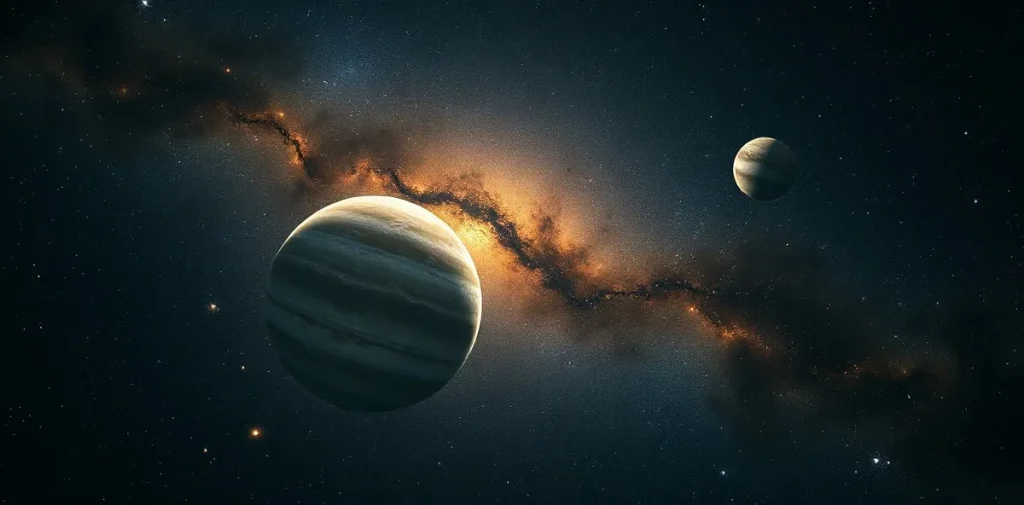
Planets are worlds with different structures and conditions, whose names are tied to ancient myths and traditions of observing the sky. In the Solar System, they differ in size, composition, atmosphere, and distance from the Sun: some are made mostly of rock, while others consist of gas and ice.
The planets’ names recall gods whose images people associated with prominent celestial objects, while the worlds themselves show just how diverse a planetary system can be. Understanding their names and differences reveals the connection between the history of astronomy and the structure of the cosmos. Our article “The Biochemical Composition of Planetary Atmospheres: Gases, Impurities, and Possible Signs of Life” explores their atmospheres.
| Planet | Name connection | Atmospheric feature |
|---|---|---|
| Mercury | Roman messenger god | No dense atmosphere |
| Venus | Roman goddess of love and beauty | Dense envelope, mostly carbon dioxide |
| Earth | Not named after a deity | Nitrogen and oxygen |
| Mars | Roman god of war | Thin envelope, mostly carbon dioxide |
| Jupiter and Saturn | Roman gods | Mostly hydrogen and helium |
| Uranus and Neptune | Greek god of the sky and Roman god of the sea | Hydrogen, helium, and methane |
- 8 planets the number of planets in the accepted list of the Solar System
- 4 planets the number of inner planets: Mercury, Venus, Earth, and Mars
- 4 planets the number of giant planets: Jupiter, Saturn, Uranus, and Neptune
Which planets are in the Solar System, and where did their names come from?
The Solar System has eight planets: Mercury, Venus, Earth, Mars, Jupiter, Saturn, Uranus, and Neptune. The first five bright planets—Mercury, Venus, Mars, Jupiter, and Saturn—have been known since antiquity: they are visible in the sky without a telescope, and their names are associated with Roman deities.
From gods to Earth
The names Uranus and Neptune continue the mythological tradition, but refer to different cultures: Uranus is named after the Greek god of the sky, while Neptune is named after the Roman god of the sea. Thus, a Greek deity’s name and a Roman deity’s name appear side by side in the same list.
Earth is the exception among planets named after gods. The English name Earth comes from an ancient Germanic root, while its Russian equivalent, Земля, is related to the word for “land” or “soil”; both names differ from the mythological names of the other planets.
How do the four inner planets differ?
The four inner planets differ in their atmospheres, surfaces, and presence of liquid water: Mercury has almost no dense atmosphere, Venus is shrouded in carbon dioxide clouds, Earth has a nitrogen-oxygen envelope and liquid water, and iron oxide gives Martian dust its color.
Mercury and Venus
- Mercury is the closest planet to the Sun and the smallest of the eight. Its surface is covered with craters, and it has no dense atmosphere.
- Venus is surrounded by a dense atmosphere consisting mostly of carbon dioxide. Its clouds contain droplets of sulfuric acid—another difference from nearly airless Mercury.
Earth and Mars
- Earth differs from its neighboring planets in having both a nitrogen-oxygen atmosphere and liquid water on its surface.
- Mars looks reddish because of iron oxide in its surface dust. Like Venus’s, its thin atmosphere consists mainly of carbon dioxide, but it is not dense.
What are the atmospheres of the giant planets made of?
The atmospheres of the giant planets are gaseous envelopes: hydrogen and helium predominate on Jupiter and Saturn, while methane is also present on Uranus and Neptune, giving the planets their characteristic hues. The difference between the two pairs is related to their composition and how their atmospheres interact with light.
Gas giants
Jupiter is the largest planet in the Solar System; its gaseous envelope consists mainly of hydrogen and helium. Saturn is also a hydrogen-helium giant, but is best known for its rings, made of ice and rock particles.
Ice giants
Uranus and Neptune are called ice giants: their atmospheres contain hydrogen, helium, and methane. Methane absorbs red light, changing the appearance of the reflected light: Uranus has a blue-green hue, while Neptune is blue.
- Jupiter and Saturn: hydrogen-helium atmospheres; Saturn stands out for its rings of ice and rock particles.
- Uranus and Neptune: atmospheres containing hydrogen, helium, and methane; methane’s absorption of red light is associated with Uranus’s blue-green color and Neptune’s blue color.
Why are planet names easy to confuse with the names of gods?
Planet names are easy to confuse with the names of gods because seven of the eight planets in the Solar System are named after mythological figures. Earth is the exception: its name is not associated with a deity, while the other seven planets have mythological origins.
Mercury, Venus, and Mars are named after Roman gods: Mercury was a messenger, Venus was the goddess of love and beauty, and Mars was the god of war. Each planet’s name can therefore be linked to a specific figure in Roman mythology, rather than treated as merely an unusual astronomical term.
Names from different pantheons
Jupiter and Saturn also reflect the Roman tradition: Jupiter is the supreme god, while Saturn is associated with agriculture and time. Uranus and Neptune add names from different pantheons to the list: Uranus comes from Greek mythology, and Neptune from Roman mythology.
A useful tip: of the eight planets in the Solar System, only Earth is not named after a mythological deity. The other seven have such names: Mercury, Venus, Mars, Jupiter, Saturn, Uranus, and Neptune.
When does the list of planets exclude Pluto?
In the current list of the Solar System, Pluto is not one of the eight planets: it is classified as a dwarf planet. So a list of eight planets and a list that also includes dwarf planets are different lists, not contradictory counts.
Pluto often appears in school lists of planets because of an earlier classification that persists in older materials and familiar diagrams. To avoid mistakes, check which category an object belongs to: planet or dwarf planet. These labels are not interchangeable.
How to read lists of celestial bodies
- Eight planets: a list of the planets in the Solar System that does not include Pluto.
- A broader list: a list of Solar System bodies that may include both planets and dwarf planets, including Pluto.
If a source gives a number of objects, first check whether it counts only planets or covers a broader category of bodies. This makes it clear why Pluto appears in one list but not another.
How can you quickly match a planet’s name to its atmosphere?
You can quickly match planet names to their atmospheres by composition: Mercury has almost no atmosphere, carbon dioxide predominates on Venus and Mars, and nitrogen and oxygen on Earth; gas giants and ice giants differ in whether methane is present.
- Mercury: has almost no atmosphere.
- Venus: a dense carbon dioxide envelope with sulfuric acid clouds.
- Earth: an atmosphere consisting mostly of nitrogen and oxygen.
- Mars: a thin envelope, mostly carbon dioxide.
- Jupiter and Saturn: the main components of their atmospheres are hydrogen and helium.
- Uranus and Neptune: hydrogen and helium combine with methane.
For an easy way to remember, divide the planets into three groups: almost airless—Mercury; mostly carbon dioxide—Venus and Mars; hydrogen and helium—Jupiter, Saturn, Uranus, and Neptune. Earth stands out for its nitrogen-oxygen composition, while methane helps distinguish the atmospheres of Uranus and Neptune from those of Jupiter and Saturn.
For a detailed look at gas composition, impurities, and possible biosignatures, read this site’s article “The Biochemical Composition of Planetary Atmospheres: Gases, Impurities, and Possible Signs of Life.”
Frequently asked questions
How many planets are in the Solar System?
Which planets are named after Roman gods?
Which planet has an atmosphere made of carbon dioxide?
Why do Uranus and Neptune look blue?
Key takeaways
- There are eight planets in the Solar System; Pluto is a dwarf planet.
- Seven planets have names associated with mythology; Earth is the exception.
- Venus and Mars have carbon dioxide atmospheres, but Venus’s is dense and Mars’s is thin.
- Jupiter and Saturn are gas giants; Uranus and Neptune are ice giants with methane in their atmospheres.
