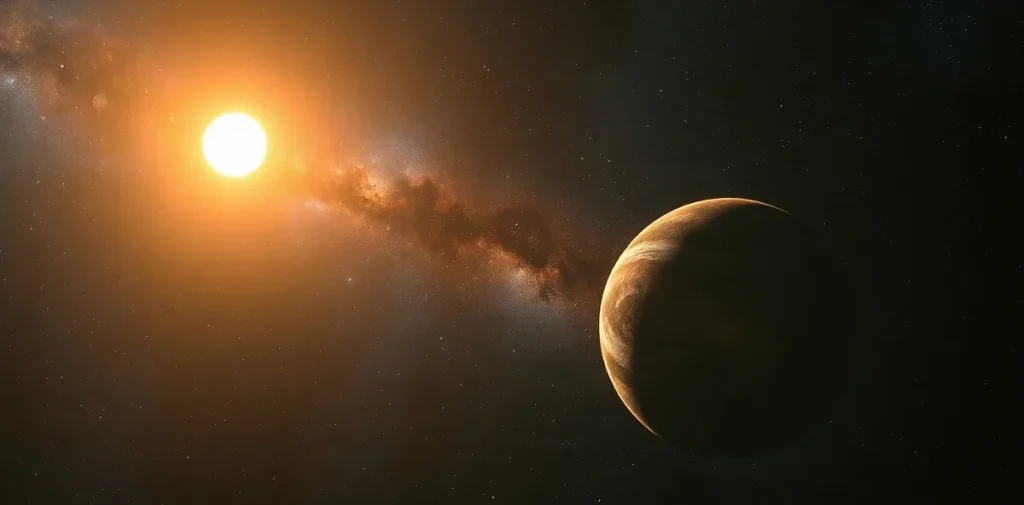
Planetary atmospheres are detected and analyzed through radiation that passes through or reflects off the gaseous envelope: the spectrum helps determine its composition and properties. This is how scientists study both worlds in the Solar System and distant exoplanets—even when their surfaces cannot be resolved.
Each gas leaves characteristic features in a spectrum, but interpreting them depends on atmospheric conditions and the specifics of the observations. So searching for and analyzing planetary atmospheres involves not only detecting individual substances but also trying to understand how the gaseous envelope works as a whole. For more on which gases and trace compounds may be present and why scientists look for them, see our guide, “The Biochemical Composition of Planetary Atmospheres: Gases, Trace Compounds, and Possible Signs of Life.”
| Method | Signal measured | What can be learned |
|---|---|---|
| Transits | Drop in a star’s brightness | Planet’s period and relative size |
| Radial velocities | Shift in the star’s spectral lines | Planet’s minimum mass |
| Direct imaging | Light from the planet itself | Some properties of an individual world |
- 3 methods are the main approaches covered: transits, radial velocities, and direct imaging
- 2 observations are compared for transit spectroscopy: the spectrum during a transit and outside it
- 1 star is the light source whose transit is used to estimate a planet’s size relative to the star
What is a planet beyond the Solar System?
An exoplanet is a planet orbiting a star beyond the Solar System; Earth and Mars are not exoplanets. These worlds vary in mass, size, orbit, and composition, so “exoplanet” does not refer to a single type of object but to a broad category of planets beyond our system.
Different worlds, different atmospheres
Known types of exoplanets include gas giants, rocky worlds, and planets of intermediate size. These differences matter when studying atmospheres: the composition and properties of a gaseous envelope depend, among other things, on the kind of planet it surrounds and its position relative to its star.
A “hot Jupiter” is not the name of an individual world but a category of gas giants orbiting close to their stars. For background on gases and trace compounds in planetary atmospheres, read our guide, “The Biochemical Composition of Planetary Atmospheres: Gases, Trace Compounds, and Possible Signs of Life.”
How does the transit method detect a planet?
The transit method detects a planet through a small, recurring dip in a star’s brightness as the planet passes in front of its disk; the intervals between dips are used to estimate the orbital period. The depth of the dip helps determine the planet’s size relative to the star: a larger world blocks a greater fraction of the star’s visible disk.
What recurring transits tell us
Recurring dips make it possible to distinguish a regular signal from a one-off change in brightness and to determine how often a planet returns to the line of sight between Earth and the star. Finding this pattern requires long-term measurements: the Kepler telescope observed stars over an extended period, detecting periodic transits.
NASA’s TESS mission uses the same method, surveying bright nearby stars and finding candidates for follow-up observations. Kepler and TESS both use transits, but their roles in the search described here differ: Kepler’s long-term observations help reveal recurring patterns, while TESS identifies candidates around bright nearby stars.
How do a star’s wobbles reveal an invisible planet?
A planet is revealed by periodic shifts in its star’s spectral lines: the gravity of the unseen world makes the star move, while the Doppler effect changes the observed wavelengths of its light. From the alternating shifts, astronomers determine how the star is moving along the line of sight—toward us or away from us.
The radial velocity method measures this motion and allows scientists to estimate the planet’s minimum mass. One instrument used for such measurements was the HARPS spectrograph on an ESO telescope at the La Silla Observatory: it recorded changes in stellar spectra associated with the stars’ wobbles.
How to determine mass and radius
Radial velocity measurements combined with transit observations provide a fuller description of a planet. A transit helps determine its radius, while the mass measured from the star’s motion, combined with the radius, allows scientists to estimate the world’s average density—a clue to its internal composition.
How does spectroscopy reveal atmospheric composition?
What exactly does a spectrum measure?
Spectroscopy reveals the composition of an exoplanet’s atmosphere by identifying wavelengths of starlight absorbed by its molecules and atoms. During a transit, some of the star’s light passes through the planet’s atmosphere, leaving characteristic features of gases in the spectrum; comparing observations during and outside the transit helps distinguish these features from the star’s own spectrum.
The James Webb Space Telescope conducts spectroscopic observations of exoplanets. Spectral features are used to study water, carbon dioxide, methane, and sodium, among other substances. However, detecting a signal does not automatically mean that life exists on the planet: it indicates a substance, not its biological origin.
Interpreting a spectrum depends on an atmospheric model: temperature affects the properties of the signal, clouds may conceal some of it, and the assumed composition helps explain the observed features. So conclusions about gases come from comparing the spectrum with a model, not from a single match on a graph.
When do search and analysis methods give an incomplete picture?
Search and analysis methods give an incomplete picture when the system’s geometry, stellar motion, or atmospheric properties conceal the signal being sought. That is why transit observations, radial velocity measurements, spectra, and direct images complement one another: each method is sensitive to different characteristics of a planet.
Why a missing signal does not always mean there is no planet
The transit method detects a planet only if its orbit is oriented so that, from the observer’s point of view, the planet passes in front of the star’s disk. If the alignment is not right, there will be no transit, even if the planet exists. The radial velocity method, by contrast, detects a star’s motion along the line of sight, but without additional data it gives the planet’s minimum mass, not necessarily its full mass.
Atmospheric spectra can also leave part of the picture hidden: clouds and haze obscure features of gases in the lower layers, so the absence of a noticeable spectral line does not, by itself, prove that the gas is absent. Direct imaging is made difficult by the brightness of the star next to a faint planet; the limitations of different methods can be compared as follows:
- Transit: shows a planet passing in front of the star’s disk, if the orbit is oriented appropriately from our viewpoint.
- Radial velocities: measure the star’s motion along the line of sight and give the minimum mass without additional data.
- Spectrum and direct imaging: clouds and haze make atmospheric analysis more difficult, while a bright star makes it hard to distinguish a faint planet.
Frequently asked questions
Can an exoplanet be seen directly?
What does an exoplanet transit show?
How do scientists find out whether an exoplanet’s atmosphere contains water?
Does detecting a gas prove that life exists?
Key takeaways
- Transits reveal periodic dips in a star’s brightness and help estimate a planet’s size.
- Radial velocities measure a star’s motion and provide an estimate of its planet’s minimum mass.
- James Webb spectroscopy makes it possible to study atmospheric features, including the absorption of light by gases.
- Clouds, orbital geometry, and a star’s brightness limit the sensitivity of different methods.
