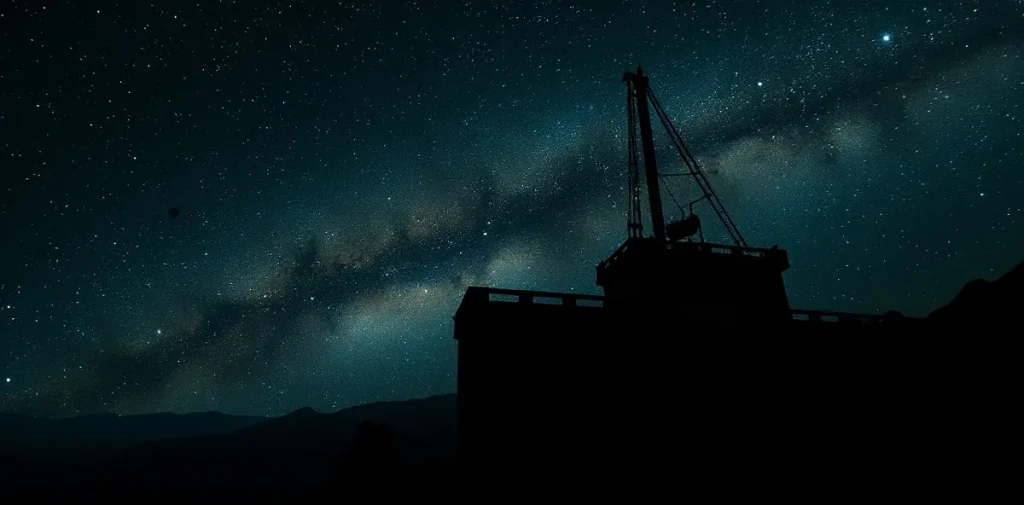
An astronomical observatory is a facility for observing celestial objects, where telescopes and auxiliary equipment are protected and configured for scientific work.
Its design depends on the goals and conditions of observation: the telescopes matter, but so do the site where they are installed, protection from light and weather, and instruments for detecting radiation. An observatory, then, is more than a building with a large telescope.
Let’s look at the components of an observatory and how the telescopes used there differ.
| Criterion | Ground-based | Space-based |
|---|---|---|
| Location | On Earth’s surface | In orbit around Earth |
| Available observations | Radio and visible parts of the spectrum | Wavelengths that do not pass through the atmosphere |
| Main limitation | Atmospheric turbulence and light pollution | Not a universal replacement for ground-based instruments |
| When to choose | When the required range is accessible from the surface | When the required radiation does not pass through the atmosphere |
- 1980 г. year the International High-Altitude Observatory at Peak Terskol was founded
- R = 50 000 spectrograph resolution for observations of stellar objects
- 3900–10 000 ÅÅ spectrograph wavelength range
- май 1954 г. time when the observatory was reopened and expanded
What is an astronomical observatory, and how is it different from a telescope?
An astronomical observatory is a site with one or more permanently installed telescopes; a telescope is just one of its instruments. An observatory brings together an optical tube or radio telescope, shelter, and equipment for detecting signals.
A ground-based optical observatory receives visible light, while a radio observatory receives radio waves; these are different parts of the electromagnetic spectrum. For example, the Kourovka Astronomical Observatory operates the SBG telescope and the robotic RoboPhot telescope. The mere presence of a telescope does not make these instruments interchangeable: each detects its own range of radiation.
A space observatory operates in orbit and receives radiation at wavelengths that do not pass through Earth’s atmosphere. Its location makes it possible to observe ranges inaccessible to ground-based telescopes.
An observatory is a complex
A telescope’s job is to collect radiation and direct it to an instrument. The shelter protects the equipment and allows observations to be made, while detection systems turn the signal into data for analysis. The result therefore depends on the coordinated work of the entire complex, not just on image magnification.
An observatory can change its equipment and conduct observations with different telescopes. In May 1954, the observatory was reopened and expanded.
How do the dome, mount and detector work?
The dome shelters a permanently installed telescope from the environment, the mount supports and points the tube, and the detector records the collected light for analysis.
From pointing to detection
The dome is opened toward the selected part of the sky: through the opening, the telescope can access the target region while remaining protected on the other sides. The mount supports the tube and moves it to track the celestial object, compensating for its apparent motion across the sky. This keeps the target in the instrument’s field of view during an observation.
A detector does more than pass an image to the eye: it captures light so it can be studied. The choice of instrument depends on the goal of the observation.
- An optical system makes it possible to study an object’s image.
- A spectrograph separates light by wavelength; the resulting spectrum shows how radiation is distributed across those wavelengths.
These detection methods answer different questions: an optical image shows the object, while a spectrograph analyzes its light by wavelength. The detector is chosen according to what needs to be learned about the object.
Which telescopes operate at one observatory?
A single observatory can operate telescopes of different models: this site has a Zeiss-2000, a Zeiss-600, the ATsU-26 solar telescope, an Astrosib-500, and a Meade LX200. The name of an observatory does not mean it has only one telescope.
Each instrument supports observations with its own equipment. Several models in one complex therefore expand the range of available observing methods rather than duplicate the same telescope.
A spectrograph for observing stellar objects
A high-resolution spectrograph is available for obtaining spectra of stellar objects. Its resolution is R = 50 000, and its wavelength range is 3900–10 000 ÅÅ.
Resolution indicates how finely the instrument can distinguish details in a spectrum; the range specifies which part of the light it detects. Together, these parameters determine what spectral data can be obtained.
How do ground-based and space observatories differ?
A ground-based observatory observes in ranges that pass through Earth’s atmosphere, while a space observatory covers ranges where atmospheric absorption interferes with observations. The advantage of each therefore depends on the wavelength and the scientific goal.
- Ground-based observatory. Radio and visible light can be observed from Earth’s surface. A high-altitude location reduces the effects of the atmosphere and light pollution, but does not eliminate atmospheric interference entirely.
- Space observatory. It makes it possible to observe radiation that the atmosphere blocks or absorbs. The choice between a ground-based and space telescope depends on which range is needed for a particular task.
How an observatory site is chosen
Altitude, atmospheric conditions and light-pollution levels matter when choosing a site for a ground-based observatory. These factors affect observing quality, but their importance varies with the wavelength and the task: a high-altitude site alone does not take a telescope beyond the atmosphere.
The International High-Altitude Observatory at Peak Terskol was founded in 1980 at Peak Terskol. Its location shows how a high-altitude site can be used for astronomical observations; atmospheric conditions and light pollution must still be considered when choosing a site.
What can you see at a professional or amateur observatory?
At professional and amateur observatories, celestial objects can be observed and their properties measured; the available tasks depend on the telescope, detector and site conditions.
A professional observatory is not necessarily intended for visual observations. For example, a spectrograph installed there records an object’s spectrum—the distribution of light by wavelength—which is used to study its physical properties. Ground-based telescopes operate in ranges accessible through the atmosphere, including visible light and radio waves.
At an amateur observatory, observers study objects that are accessible in the chosen range and suited to the equipment’s capabilities. Visual observing requires a telescope that produces the required image; to detect light, the detector must be sensitive to the relevant range.
What determines the result of an observation?
- Optics: affect image quality and which details can be distinguished.
- Mount: supports the telescope and allows it to be pointed at an object.
- Detector: determines whether an object can not only be seen but also have its radiation recorded for measurement.
- Site conditions: atmospheric turbulence and light pollution can limit observations.
That is why a telescope’s diameter alone does not show how well an observatory will handle a particular task.
An observatory’s history may include restoration and expansion: one observatory was reopened and expanded in May 1954. For a specific site, details of its history and equipment should be checked against the observatory’s own description.
When does an observatory offer no advantage?
An observatory offers no advantage when atmospheric conditions or light pollution interfere with observing the target: the dome protects the telescope but does not remove these limitations.
A ground-based telescope works through the atmosphere. Turbulence distorts the image, while light pollution makes observations more difficult; even a high-altitude site cannot guarantee good results when conditions are poor.
A space observatory does not replace a ground-based one for every task: the choice depends on whether the atmosphere lets the required range of radiation through. Ground-based observatories are used for observations in the radio and visible ranges, while orbiting observatories can study wavelengths that do not pass through Earth’s atmosphere.
Remote operation makes it possible to work with a site that is inconvenient for an observer to reach, but it does not expand an instrument’s capabilities. The robotic RoboPhot telescope at the Kourovka Observatory can be operated remotely, but the telescope and its detector still determine the observing range.
- Ground-based site: check how much atmospheric turbulence and light pollution interfere with observations.
- Space observatory: find out whether the required radiation passes through the atmosphere.
- Telescope and detector: before choosing equipment, determine the required range and make sure the instrument is designed for it.
Frequently asked questions
How is an observatory different from an ordinary telescope?
Why does a telescope need a dome?
Why does an observatory need a spectrograph?
Can observations be made from home?
Key takeaways
- An observatory is a complex of instruments and a site, not another word for a telescope.
- The dome shelters the telescope, the mount points it, and the detector records the signal.
- Space observatories are needed for ranges that do not pass through Earth’s atmosphere.
- The spectrograph in the example given operates at R = 50 000 and covers the 3900–10 000 ÅÅ range.
Sources
- baike.baidu.com — “Astronomical Telescope”
- baike.baidu.com — “Kourovka Astronomical Observatory of Ural Federal University_Baidu Encyclopedia”
- tutu.ru — “Why Go on an Astronomical Trip”
- sciencejournals.ru — “Astronomical Journal. Vol. 100, No. 7, 2023”