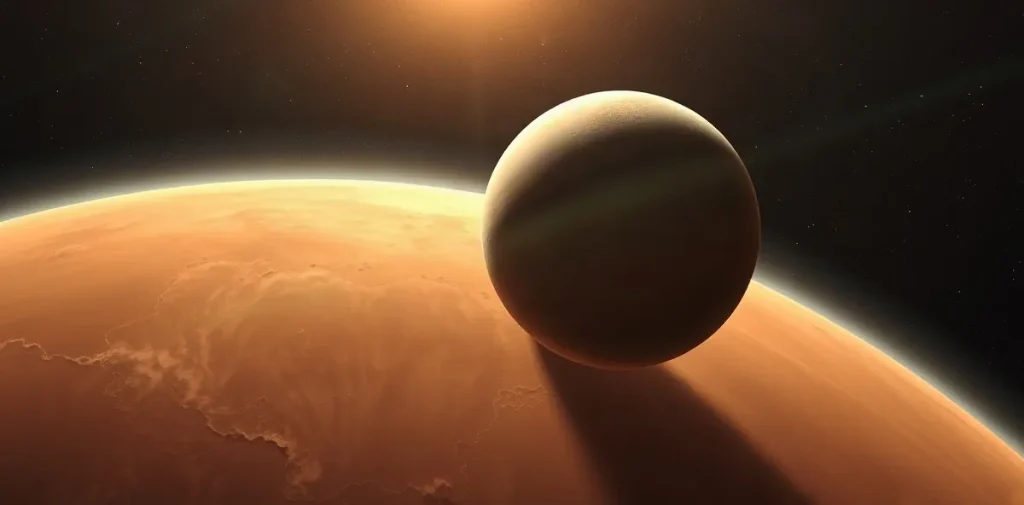
Scientific studies of Titan, Saturn’s largest moon, continue to amaze astronomers with its unique features. Titan’s north pole is dotted with lakes, making this celestial body a true wonder in our Solar System. These lakes, primarily composed of methane and ethane, open new horizons for studying atmospheric and climatic processes under the moon’s exotic conditions.
Recent data obtained from the orbital spacecraft Cassini and the Huygens probe confirm that these bodies of liquid play a key role not only in shaping Titan’s surface but also its atmosphere. Scientists are increasingly interested in exploring this mysterious world, as it may provide important clues about potential forms of life on other planets and about processes occurring in environments far removed from those familiar to us.
| Parameter | Titan | Earth |
|---|---|---|
| Atmosphere | 95% nitrogen, 5% methane | 78% nitrogen, 21% oxygen |
| Temperature | -179 °C | 0 °C — 50 °C |
| Pressure | 1.5 atmospheres | 1 atmosphere |
- 25,000 km² Area of the largest lake on Titan
- -179 °C Surface temperature on Titan
- 1.5 atmospheres Surface pressure on Titan
Methane Lakes of Titan
The methane lakes of Titan, Saturn’s largest moon, represent a unique object for astrophysical research. In particular, more than 400 lakes have been discovered at Titan’s north pole, with the largest, Kraken Lake, covering an area of about 25,000 km². These lakes are mainly composed of liquid methane and ethane, making them analogs to Earth’s bodies of water; however, the surface temperature on Titan drops to -179 °C, which significantly affects the physical properties of these hydrocarbons.
Depth and Composition of the Lakes
According to data obtained during the Cassini mission, the depth of some lakes may exceed 170 meters. These studies suggest that the composition and structure of the methane lakes may vary. Scientists hypothesize that in some locations underwater methane sources may exist, indicating active geological processes on Titan.
- Largest lake area: 25,000 km²
- Surface temperature: -179 °C
- Lake depth: up to 170 m
Space Missions and Research
The Cassini Mission
The Cassini-Huygens mission, which concluded in 2017, was a landmark event in the study of Saturn and its moons, including Titan. Over 13 years of operation, the Cassini spacecraft collected extensive data on Titan’s atmospheric composition, surface, and unique meteorological phenomena. One of the key discoveries was the presence of large lakes and seas of hydrocarbons, making Titan unique among other moons in the Solar System. Research showed that lakes cover about 1.5% of Titan’s surface, approximately 300,000 square kilometers.
Future Research
In 2026, NASA plans to launch a new mission called Dragonfly, which will explore Titan using a multi-purpose drone helicopter. The primary goal of the mission is to study the moon’s chemical composition and geology, as well as to search for possible signs of life. The mission’s estimated cost is around 1 billion dollars. Dragonfly will be capable of flying distances up to 8 kilometers, allowing it to investigate diverse regions of Titan within days.
- Dragonfly mission launch — 2026.
- Mission budget — about 1 billion dollars.
- Helicopter range — up to 8 kilometers per flight.
- Area of Titan’s lakes — 300,000 square kilometers.
Atmosphere and Climate of Titan
Titan’s atmosphere, Saturn’s largest moon’s, is a unique subject of study. It consists of 95% nitrogen and 5% methane. This combination makes Titan’s atmosphere analogous to Earth’s but with characteristics that influence its climate and weather conditions. The surface pressure on Titan is 1.5 atmospheres, which is 1.5 times Earth’s pressure. This high pressure creates unique conditions for methane to exist in liquid form, leading to the formation of lakes and rivers on the moon’s surface.
Seasonal Changes on Titan
Seasonal changes on Titan occur every 7.5 Earth years, corresponding to one full orbit of the moon around the Sun. These changes affect the distribution of methane in both the atmosphere and on the surface. For instance, when Titan is closer to the Sun, an increase in methane clouds and precipitation occurs, filling the lakes. Conversely, during periods when Titan moves farther from the Sun, methane evaporation increases, decreasing liquid levels.
- Atmosphere composition: 95% nitrogen, 5% methane
- Surface pressure: 1.5 atmospheres
- Seasonal cycle: 7.5 Earth years
Geology and Surface Structure
Titan’s geology and surface structure are uniquely complex and varied. Observations made by the Cassini space probe showed that about 40% of Titan’s surface is covered by liquid, mainly methane and ethane. These hydrocarbons form extensive lakes and seas, making Titan the only known celestial body besides Earth that has stable liquid surfaces. The heights of mountainous formations on Titan reach up to 1.5 kilometers, and they are primarily composed of water ice, indicating complex geological processes occurring on this moon.
Organic Compounds and Their Impact
Titan’s surface is scattered with organic compounds that create diverse geological structures. These compounds likely form through photochemical reactions in Titan’s atmosphere and interactions with ultraviolet radiation. As a result, complex structures emerge, which may include both simple and complex molecules, and their distribution across the surface may indicate the presence of underground processes.
- Liquid coverage: 40% of the surface
- Mountain height: up to 1.5 km
- Mountain composition: water ice
Potential for Life and Scientific Conclusions
Research on Titan, Saturn’s moon, opens new horizons in the search for extraterrestrial life. Scientific data show that the methane lakes covering Titan’s north pole may create conditions similar to those in Earth’s most extreme environments. For example, the surface temperature on Titan hovers around -179 degrees Celsius, making the existence of methane-based organisms theoretically possible. Scientists at MIT suggest that such organisms might use methane as an energy source, opening new perspectives for astrophysics and biology.
Scientific Conclusions and Prospects
According to NASA, Titan has become one of the most intriguing objects for study. Research conducted during the Cassini mission showed that methane lakes cover approximately 1.6% of the moon’s surface, about 300,000 square kilometers. These findings provide a foundation for further studies that could reveal not only the presence of life but also its possible forms.
- Temperature on Titan: -179 °C
- Area of methane lakes: 300,000 km²
- Percentage of surface covered by lakes: 1.6%
- Presumed energy source for life: methane
Frequently Asked Questions
What makes Titan unique among other moons?
Which spacecraft has explored Titan?
What is the surface temperature on Titan?
Key Takeaways
- Titan has more than 400 methane lakes.
- According to NASA, the Dragonfly mission costs around 1 billion dollars.
- Titan’s atmosphere consists of 95% nitrogen.