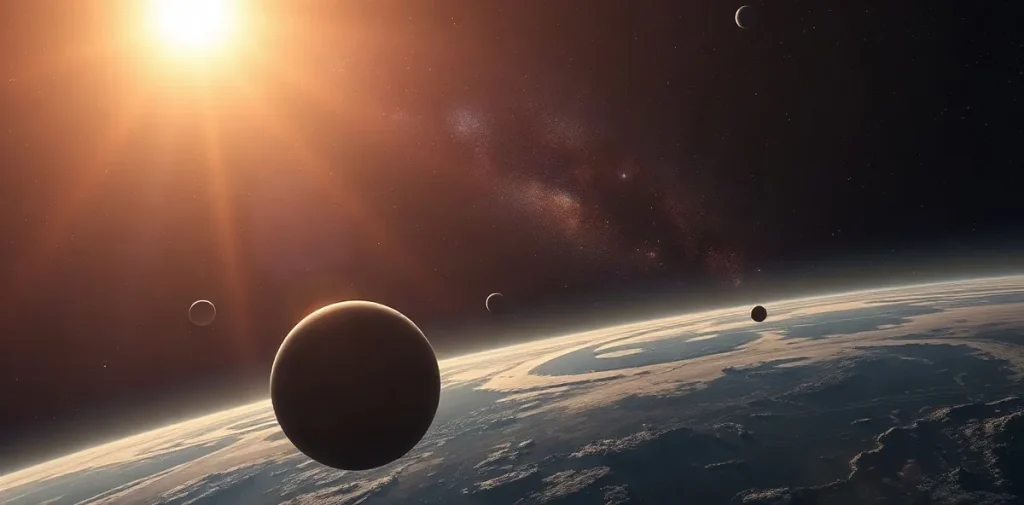
A planet’s mass and diameter directly determine its ability to retain an atmosphere and influence climatic conditions on its surface. The greater the mass and diameter, the stronger the gravitational pull capable of holding a denser atmosphere, leading to diverse climatic phenomena and the stability of the climate system.
Understanding exactly how a planet’s physical parameters affect its atmosphere and climate is key not only for studying Earth but also for exploring other planets both within our Solar System and beyond. The influence of mass and diameter manifests in shaping atmospheric composition, pressure, temperature regimes, and even protecting the surface from cosmic impacts.
Examining the relationship between mass, diameter, atmosphere, and climate helps reveal the mechanisms controlling climatic processes and predict conditions in which life might exist. This is crucial for astrophysics, planetary science, and the search for potentially habitable worlds.
| Planet | Mass (kg) | Diameter (km) | Atmospheric Pressure (Pa) | Average Surface Temp. (K) |
|---|---|---|---|---|
| Earth | 5.97×10^24 | 12,742 | 101,325 | 288 |
| Venus | 4.87×10^24 | 12,104 | 9,300,000 | 735 |
| Mars | 6.42×10^23 | 6,779 | 600 | 210 |
- 5.97×10^24 kg Earth’s mass
- 12,742 km Earth’s diameter
- 9.3 MPa Atmospheric pressure on Venus
- 600 Pa Atmospheric pressure on Mars
- 60 °C Daily temperature swings on Mars
How Does a Planet’s Mass Determine Its Gravitational Retention of Atmosphere?
A planet’s mass directly determines its ability to hold onto an atmosphere through gravitational attraction, which prevents gases from escaping into space. The greater the mass, the stronger the gravitational field, and the denser and more stable the atmosphere can be.
Effect of Mass on Gravitational Field
A planet’s gravitational field is proportional to its mass. For example, Earth, with a mass of 5.97×1024 kg, has enough gravitational pull to retain an atmosphere with an average density around 1.2 kg/m³ at sea level. In contrast, Mars, with a mass roughly nine times smaller—6.42×10²³ kg—has a weaker gravitational field, and its atmosphere has a pressure of only about 600 Pa, which is just 0.6% of Earth’s.
Correlation Between Mass and Atmospheric Pressure
Mass influences atmospheric pressure by retaining gases. Venus, with a mass of 4.87×1024 kg and gravity about 0.9 times Earth’s, holds an extremely dense atmosphere with a pressure of 9.3 MPa, over 90 times that of Earth. This shows that even with slightly lower gravity, significant mass allows a planet to maintain a thick and heavy atmosphere.
- Earth: mass 5.97×1024 kg, atmospheric pressure ~101,325 Pa
- Mars: mass 6.42×10²³ kg, atmospheric pressure ~600 Pa
- Venus: mass 4.87×1024 kg, atmospheric pressure 9.3 MPa
Why Does a Planet’s Diameter Affect Atmospheric Temperature and Climate?
A planet’s diameter directly affects the temperature and climate of its atmosphere because it determines surface area and thermal inertia, influencing the ability to retain heat and regulate daily and seasonal temperature fluctuations.
Diameter’s Connection to Thermal Inertia
A larger diameter, like Earth’s 12,742 km, provides significant surface area that promotes the accumulation and distribution of heat, reducing sharp temperature changes. By contrast, Mars, with a diameter of only 6,779 km, has lower thermal inertia, causing daily temperature swings up to 60 °C. This is because the smaller mass and surface area cannot retain accumulated heat for long, leading to rapid heating and cooling.
Diameter and Climate Stability
Venus’s large diameter, exceeding 12,100 km, supports the formation of a dense atmosphere that effectively traps heat, causing a strong greenhouse effect and surface temperatures around 735 K. Climate stability on such planets depends on the atmosphere’s ability to maintain thermal balance, closely linked to the planet’s size and gravitational pull.
- Earth’s diameter: 12,742 km — diverse climate zones
- Mars’s diameter: 6,779 km — daily temperature swings up to 60 °C
- Venus’s diameter: about 12,100 km — surface temperature ~735 K
How Does Atmospheric Composition Depend on a Planet’s Physical Properties?
A planet’s atmospheric composition directly depends on its mass and diameter, which determine the strength of gravity and the ability to retain various gases. For instance, Venus, with a mass of about 4.87×1024 kg and diameter of 12,104 km, retains 96.5% carbon dioxide in its atmosphere, while Mars, with a mass of 6.42×10²³ kg and diameter of 6,779 km, has a thin atmosphere with roughly 95% CO2 but at a low pressure of about 600 Pa. Earth, possessing a mass of 5.97×1024 kg and diameter of 12,742 km, holds 78% nitrogen and 21% oxygen thanks to stronger gravity and biological processes.
Gravity’s Role in Gas Retention
A planet’s gravity determines which gases can remain in the atmosphere without escaping into space. Mars’s lower mass results in weaker gravity, so light gases escape quickly, and atmospheric pressure doesn’t exceed 0.6 kPa. Venus and Earth, having greater mass and diameter, retain heavier and more diverse gas mixtures. Venus, lacking a magnetic field, loses light gases, explaining the dominance of CO2, while Earth maintains an oxygen-nitrogen atmosphere supported by its biosphere.
Role of Magnetic Field and Biosphere
- Venus: absence of a magnetic field contributes to loss of light gases, resulting in 96.5% CO2;
- Mars: weak magnetic field and low mass cause a thin atmosphere with low pressure around 600 Pa;
- Earth: magnetic field and biosphere sustain 78% nitrogen and 21% oxygen in the atmosphere.
When Do Mass and Diameter Fail to Guarantee a Dense Atmosphere?
Mass and diameter do not ensure a dense atmosphere if gravity is too weak to retain gases or external factors destroy the atmosphere faster than it can be replenished. For example, Mercury, with a diameter of 4,880 km and mass of 3.3×10²³ kg, has virtually no permanent atmosphere despite relatively large size, due to proximity to the Sun and weak gravity.
Impact of External Factors on Atmospheric Retention
Proximity to the Sun greatly affects a planet’s ability to hold an atmosphere: intense solar radiation and solar wind accelerate gas loss. Research from Ufa in 2025 demonstrated that even large planets with masses over 5×1024 kg can lose their atmosphere if they lack sufficient protection. For instance, Mercury’s atmosphere is eroded by solar wind, making it extremely thin.
The Magnetic Field’s Protective Role
The absence of a magnetic field critically reduces a planet’s ability to retain its atmosphere. The Moon, with a diameter of 3,474 km and mass of 7.35×10²² kg, does not hold an atmosphere not only due to low mass but also lack of a magnetic field. A magnetic field deflects solar wind streams, reducing gas loss. According to the aforementioned studies, planets without magnetospheres can lose significant portions of their atmospheres over hundreds of millions of years.
- Mercury: diameter 4,880 km, mass 3.3×10²³ kg, virtually no atmosphere;
- Moon: diameter 3,474 km, mass 7.35×10²² kg, no atmosphere due to insufficient mass and lack of magnetic field;
- Threshold mass for retaining a dense atmosphere without a magnetic field exceeds several 1024 kg;
- Ufa studies in 2025 confirmed the solar wind’s role in atmospheric loss for planets lacking magnetic fields.
How Does a Planet’s Climate Change with Atmospheric Pressure?
Greenhouse Effect and Pressure
Atmospheric pressure directly influences a planet’s climate by regulating the intensity of the greenhouse effect and surface temperature. For example, Venus’s pressure of 9.2 MPa (92 times Earth’s) creates extreme conditions where temperatures reach 735 K, driven by the accumulation of greenhouse gases and their inability to dissipate. In comparison, Earth’s pressure around 101,325 Pa supports a balanced greenhouse effect, providing an average temperature of about 288 K and favorable conditions for life.
Pressure’s Influence on Water’s Phase States
Atmospheric pressure also determines the possibility of liquid water on the surface, and thus the planet’s climatic characteristics. Mars, with pressure below 600 Pa (less than 1% of Earth’s), sees liquid water rapidly evaporate or freeze, excluding stable bodies of water. Earth, at about 101,325 Pa, supports liquid water essential for the biosphere. Criteria for liquid water existence include:
- Pressure not below roughly 6.1 kPa—the triple point pressure of water;
- Surface temperature within 273–373 K;
- Atmospheric stability sufficient to retain moisture and heat.
Thus, atmospheric pressure is a key factor shaping climate and a planet’s ability to support life.
Common Limitations and Errors in Assessing the Impact of Mass and Diameter on Atmosphere
Shortcomings of Models Ignoring External Factors
Assessing the influence of a planet’s mass and diameter on its atmosphere often overlooks crucial external and internal factors, leading to inaccurate conclusions about its composition and thickness. For example, Mars’s lack of a magnetic field contributes to intense atmospheric loss due to solar wind—the thinning rate can reach several thousand tons per year, which cannot be explained by mass alone. Also, ignoring geological activity, which replenishes gases, and biological processes affecting chemical composition distorts understanding of climate.
The Importance of a Comprehensive Approach
Accurately evaluating an atmosphere requires considering chemical composition, internal heat, and magnetic field alongside mass and diameter. For instance, Venus has a dense atmosphere with pressure near 92 bar and surface temperatures over 460 °C due to greenhouse effect and geological activity. The balance of solar radiation and core activity, which forms the magnetic field protecting the atmosphere from solar wind, is also essential.
- Earth’s magnetic field: surface around 25–65 µT (microtesla), vital for atmosphere retention
- Geological activity of Io (Jupiter’s moon), supporting volcanic gas emissions
- Venus’s atmospheric pressure: 92 bar, illustrating the impact of chemical composition and internal heat
Frequently Asked Questions
Why does Venus have such a dense atmosphere despite having less mass than Earth?
How does a planet’s diameter affect daily temperature fluctuations?
Why doesn’t Mercury retain an atmosphere despite its mass and size?
Key Takeaways
- A planet’s mass determines gravitational strength and its ability to retain an atmosphere
- Diameter affects thermal inertia and climate stability
- Atmospheric composition depends on planetary physics and biological processes
- External factors like magnetic fields and solar wind are critical for atmosphere preservation
- Atmospheric pressure directly impacts climate and water’s phase states