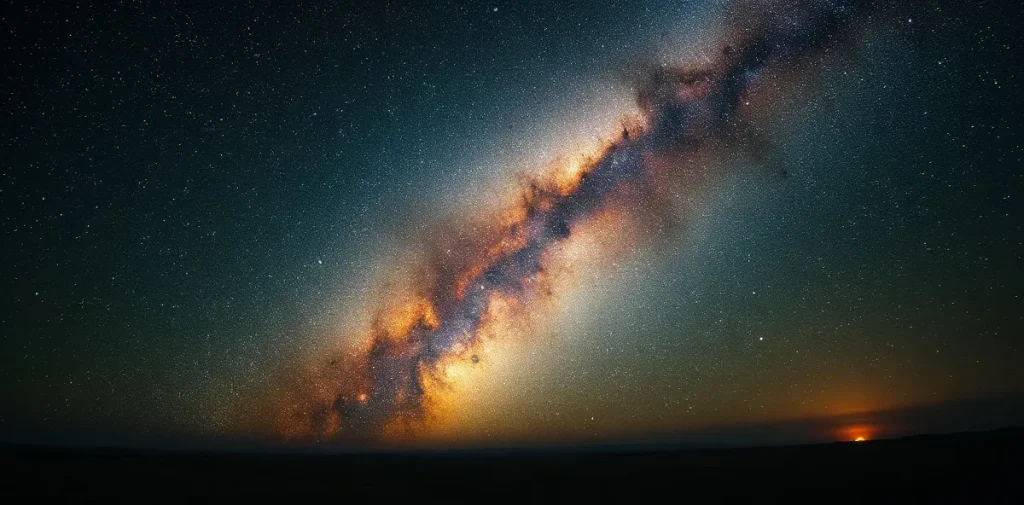
Stars are classified by mass, temperature, and luminosity, and their life cycle passes through stages from protostar to final phases — white dwarf, neutron star, or black hole. A star’s type determines its evolutionary path and lifespan.
Understanding star types and their life cycles is key to uncovering the processes that shape the Universe’s structure. From tiny red dwarfs to massive blue supergiants, each star class has unique characteristics and destiny. Studying star classification and evolution helps scientists explain cosmic phenomena and predict the future of our galaxy.
In this article, we will examine the main star types, their physical properties, and the stages of their life cycle, revealing patterns of transformation and their role in cosmic ecology. This approach clarifies how a chaotic gas cloud forms a shining star and ultimately its inevitable end.
| Star Mass (Solar Masses) | Lifespan | Final Stage | Example Star |
|---|---|---|---|
| < 0.5 | More than 50 billion years | White dwarf | Proxima Centauri (0.12) |
| ~1 | About 10 billion years | White dwarf | The Sun (1) |
| 8–20 | Several million years | Neutron star | Betelgeuse (~18) |
| > 20 | Less than 10 million years | Black hole | Star in Cygnus X-1 system |
- 0.08–150 solar masses Range of star masses by classification
- 10 billion years Lifespan of a star with 1 solar mass
- 1.4 solar masses Chandrasekhar limit — maximum mass of a white dwarf
- 10 km Approximate radius of a neutron star
How are stars classified by mass and brightness?
Mass scale of stars
A star’s mass — the primary parameter defining its type and evolution — ranges roughly from 0.08 to 150 times the mass of the Sun. Stars with less than 0.08 solar masses cannot initiate nuclear fusion and become brown dwarfs. Stars around 0.1–0.5 solar masses are red dwarfs, capable of existing for billions of years. At the high end of stellar mass are supergiants with masses from 10 to 150 solar masses, such as Betelgeuse, which has about 18–20 solar masses.
Spectral and luminosity classes
- Spectral class: from O to M, where O are the hottest stars with temperatures above 30,000 K, and M are the coolest, around 3,000 K.
- Luminosity class: from I (supergiants) to V (main sequence, or dwarfs). The Sun is classified as G2V — a yellow dwarf.
- Example: Betelgeuse is a red supergiant of class M1-2Ia-Iab with a surface temperature of about 3,500 K and luminosity far exceeding the Sun’s.
What life cycle stages do stars of different masses go through?
Life cycle of low-mass stars
Stars up to 8 solar masses pass through main sequence, red giant stages and end as white dwarfs. A star with the Sun’s mass lives about 10 billion years.
After exhausting hydrogen fuel in their cores, these stars expand into red giants, growing tens of times larger. At the end of their evolution, they shed their outer layers as planetary nebulae and remain as white dwarfs — dense remnants about 0.6 solar masses in size and comparable in radius to Earth.
Life cycle of massive stars
Stars above 8 solar masses experience main sequence and supergiant stages, ending in supernova explosions. For stars around 20 solar masses, the lifespan is less than 10 million years, as confirmed by observations of star clusters.
Once nuclear fuel is depleted, massive stars expand into supergiants where complex nucleosynthesis of heavy elements occurs. Ultimately, they explode as supernovae, leaving behind neutron stars or black holes depending on the remnant mass.
How are stars born in molecular clouds?
Star birth in molecular clouds occurs through compression and gravitational collapse of dense gas regions, especially molecular hydrogen, followed by protostar formation. The protostellar phase lasts from 0.1 to 10 million years depending on the star’s future mass, which sets the pace of its evolution.
Conditions in molecular clouds
Star formation happens in areas with densities from 100 to 10,000 particles per cubic centimeter, where the temperature is low enough to preserve hydrogen molecules. The Orion Nebula is an example of an active star-forming region, with a mass around 2,000 solar masses, providing ample material for forming many new stars.
Observation tools
- ALMA radio telescope (Atacama Large Millimeter/submillimeter Array) — allows study of protostars with resolution down to hundreds of astronomical units, greatly improving understanding of early star formation stages.
- Spectrometers and infrared telescopes — complement ALMA data, tracking the dynamics and chemical composition of molecular clouds.
Why do stars end their lives as white dwarfs, neutron stars, or black holes?
White dwarfs and the Chandrasekhar limit
Stars under 8 solar masses end evolution as white dwarfs because their cores cannot exceed the Chandrasekhar limit — about 1.4 solar masses. After exhausting nuclear fuel, the star sheds its outer layers, and the core compresses to roughly Earth’s size, staying below this critical mass.
White dwarfs are dense objects about 10,000 km in radius, composed of degenerate electron gas. Their mass does not exceed 1.4 solar masses, or electron degeneracy pressure cannot resist gravitational collapse.
Neutron stars and black holes
If a stellar core remnant after a supernova is about 1.4–2.1 solar masses, a neutron star forms. These objects, about 10 km in diameter, consist of ultra-dense neutron matter. The pulsar PSR B1919+21 — the first discovered neutron star in 1967 — is an example.
When the remnant mass exceeds roughly 2.5 solar masses, gravitational collapse becomes irreversible, forming a black hole. Gravity is so strong that neither light nor matter can escape its event horizon.
- White dwarfs: up to 1.4 solar masses (Chandrasekhar limit), radius about 10,000 km
- Neutron stars: 1.4–2.1 solar masses, radius about 10 km
- Black holes: remnant mass over ~2.5 solar masses, irreversible gravitational collapse
How does the star life cycle affect galaxy structure and chemical composition?
Role of supernovae and stellar winds
Star life cycles actively shape galaxy structure through mass and energy ejection into the interstellar medium. Supernova explosions release heavy elements and create shock waves that influence gas and dust distribution. Red giants and supergiants lose up to 10% of their mass via stellar winds, renewing and mixing interstellar matter.
For example, the mass expelled in a typical supernova can reach several solar masses, with shock wave speeds of hundreds of kilometers per second. These processes stimulate new star formation and determine interstellar medium density. In the Milky Way, supernovae and stellar winds play a key role in galactic dynamics.
Chemical enrichment of galaxies
Nucleosynthesis reactions in stars form elements heavier than helium, such as carbon, oxygen, and iron, which then enter galaxies through stellar ejecta. About 90% of heavy elements in the Milky Way originate from stellar evolution, critical for planet and life formation.
- Carbon and oxygen — key elements synthesized in medium and high-mass stars.
- Iron — formed in cores of massive stars and released during type Ia and II supernovae.
This enrichment alters the chemical makeup of gas and dust from which new star and planet generations form, providing diversity and complexity within galaxies.
When do star classification and life cycle models have limitations and errors?
Limitations of theoretical models
Star classification and life cycle models face limitations due to complex processes like convection and rotation, which significantly affect evolution stage durations. For example, models of stars around 10 solar masses show rotation can alter main sequence lifetime by tens of percent.
Additionally, models struggle to incorporate Wolf-Rayet star winds — stars with intense stellar winds that can change their spectral class during their lives. This complicates accurate predictions of their evolution and final fate, especially when wind speeds exceed 2,000 km/s.
Errors in observations
A major challenge is precisely determining masses of stars in binary systems, particularly those under 0.5 solar masses. Small errors in orbital parameter measurements lead to large uncertainties in mass, complicating theoretical model verification. Observations require angular precision better than hundredths of an arcsecond.
For very massive stars above 100 solar masses, observational data remains limited due to their rarity and high luminosity, which hampers accurate spectral and mass measurements and life cycle modeling. Thus, predictions for these stars remain less reliable.
Frequently Asked Questions
What determines a star’s spectral class?
How long do massive stars live?
What are the possible final stages of stars?
Why is stellar evolution important for galaxies?
Key Takeaways
- A star’s mass defines its classification and life cycle
- Low-mass stars live billions of years and end as white dwarfs
- Massive stars evolve rapidly and end as supernovae
- Stellar evolution enriches galaxies with heavy elements
- Evolution models have limitations due to complex processes inside stars