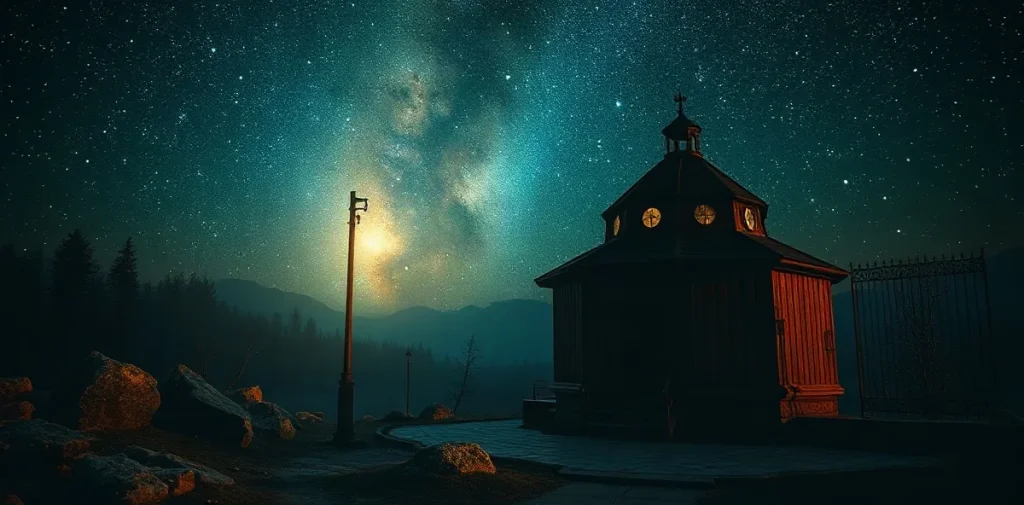
Stars are best observed away from bright streetlights and shop windows. At your observing site, use a dim red light pointed at the ground.
Light pollution makes faint stars and the Milky Way harder to see: urban glow drowns out their light. Choose a dark, open spot for observing and give your eyes time to adjust to the darkness.
Use a light only when needed, and never shine a flashlight into anyone’s eyes—your own or another observer’s.
| Option | What to check | Suitable if |
|---|---|---|
| Yard light | It does not shine upward or horizontally | The light is aimed at a path or entrance |
| Building lighting | It stays out of your line of sight and can be switched off when not needed | You need to light a façade without illuminating the observing area |
| Handheld flashlight | The beam can be aimed only at the ground | You need to move around the site briefly |
| Location outside the city | No direct lights are nearby; the map and cloud cover have been checked | You need to reduce both background and local light pollution |
How do streetlights interfere with seeing stars and preserving night vision?
Streetlights make stars harder to see when their light scatters through the lower atmosphere, while glaring light shining directly into your eyes impairs night vision.
Light pollution is artificial illumination of the night sky. Light from streetlights, buildings, and other sources that is directed upward or sideways scatters through the atmosphere, creating a bright background that makes celestial objects harder to see.
Where the light is directed
- Light directed upward or sideways. It illuminates the sky and makes astronomical observations more difficult.
- Shielded light fixture. When directed downward, it sends less light into the sky.
- Flashlight or car headlights. Glare and a beam shining into your eyes directly interfere with night vision—even if the sky above you is dark.
- Building lighting. It can make conditions for observing in a yard worse when light spills beyond the surface being illuminated.
To check the lighting around your observing site, look at where light from streetlights and other fixtures falls: light directed upward or beyond the area that needs illuminating adds to light pollution. To protect your eyes, also avoid bright beams entering your direct line of sight.
How do you choose a dark location and check conditions before setting out?
Choose a spot where streetlights and bright windows do not shine directly into your eyes, and check cloud cover and visibility before you leave: a dark location does not guarantee clear skies.
Assess light pollution first, then check the forecast.
A light pollution map helps you compare locations by the brightness of the night sky. But also assess your immediate surroundings: a nearby streetlight or illuminated window can interfere with observing even when the overall sky background is dark.
- Compare the proposed locations on a map for light pollution.
- At the site, check whether streetlights or bright windows fall directly in your line of sight.
- Before setting out, check cloud cover and visibility, then compare the forecast with a sky map.
“Light Pollution Map” combines a light pollution map with weather and aurora forecasts, information about astronomical events, Moon tools, ISS tracking, and astrophotography utilities. If you plan to do more than visual observing, these features can help you prepare in one app. “Light Pollution Map” remains available in version 5.5.2.
What can you change at home to keep light out of the sky?
To keep light out of the sky, check your outdoor fixtures, remove unnecessary light sources, and direct the remaining light at a path or entrance rather than upward or sideways.
- Audit your property. At dusk, identify streetlights, wall lights, and floodlights that shine upward or horizontally. Check where the light falls: on the sky, a neighbor’s property, or the area around your home that needs lighting.
- Correct the direction. Switch off unnecessary lights, redirect incorrectly positioned fixtures, and replace open fixtures with enclosed ones. Their housing should direct light downward—onto a path or entrance.
- Choose warm LEDs. For outdoor lighting, use LED bulbs with a color temperature of 3000 K or lower. Check the value on the packaging or in the bulb specifications.
- Switch off building lighting. If façade lighting is not needed, leave it off. Extra light does not help you observe stars and increases light pollution around your home.
After making changes, check the property again in the dark: light should stay where it is needed rather than spill beyond the area being illuminated.
What flashlight should you bring, and when won’t it help?
To move around the observing site, bring a flashlight with a downward-facing beam: use it to light the ground, not the sky or other observers. Switch it on only when necessary and for a short time—even dim direct light makes it harder for your eyes to stay adapted to the dark.
Choose a flashlight based on where its light falls, not just its color. At the site, you need to see where you are going without lighting up the sky or blinding people looking through a telescope or with the naked eye.
Don’t confuse a warm spectrum with an absence of glare
The warm spectrum of an outdoor LED fixture with a color temperature of 3000 K or lower helps reduce skyglow. But color temperature does not tell you how bright the flashlight is or where its beam is aimed: a bright light can still disturb observers.
- For walking: Aim the beam at the ground and do not leave it on.
- To reduce light pollution: A warm LED fixture rated at up to 3000 K is useful, but it does not replace controlling brightness and direction.
- When there is an outside source of glare: You cannot get rid of glaring streetlights, bright windows, or car headlights with your own flashlight.
If a bright light remains nearby, move away from it or choose another spot. Changing your flashlight will help only where you control the light source yourself.
How do you check an app before installing it?
Before installing, check the app’s exact name and developer in the store: a similar name alone does not confirm that it is the app you want.
“Light Pollution Map” remains available in version 5.5.2. The app listing names Dunbar Technology, LLC; the listing date is October 31, 2026. Check both details before downloading, not just the icon or a similar name.
What to check before a trip
- Name and developer. Find “Light Pollution Map” in the store listing and check that the developer is listed as Dunbar Technology, LLC.
- Version. Make sure the version is 5.5.2.
- Conditions at the site. Use the app to plan your trip, but separately check local lighting and the weather at your chosen location: the map does not show every observing condition at the site.
Even a suitable map cannot guarantee dark skies or clear weather. Before setting out, check the lighting at the site itself and the forecast for that location.
Frequently asked questions
How can you tell if a location is suitable for observing?
What color temperature is suitable for outdoor lighting at home?
Why can a warm flashlight still be disruptive?
What can you check in the “Light Pollution Map” app?
Key takeaways
- Keep direct light sources out of your line of sight; local glare is disruptive even outside the city.
- For lighting your property, choose shielded fixtures aimed downward and warm LEDs rated at 3000K or lower.
- Check the light pollution map against the weather forecast: a dark location may be cloudy.
- “Light Pollution Map” is available in version 5.5.2; check that the developer is Dunbar Technology, LLC.
Sources
- Slim — “How to Reduce Light Pollution at Home”
- stargazinghub.com — “Stargazing Hub: Sky Map, Light Pollution, and Auroras”
- Light Map — “Light Pollution Map | Bortle Scale | Dark Sky”
- Light Pollution Map — “Apps on Google Play”