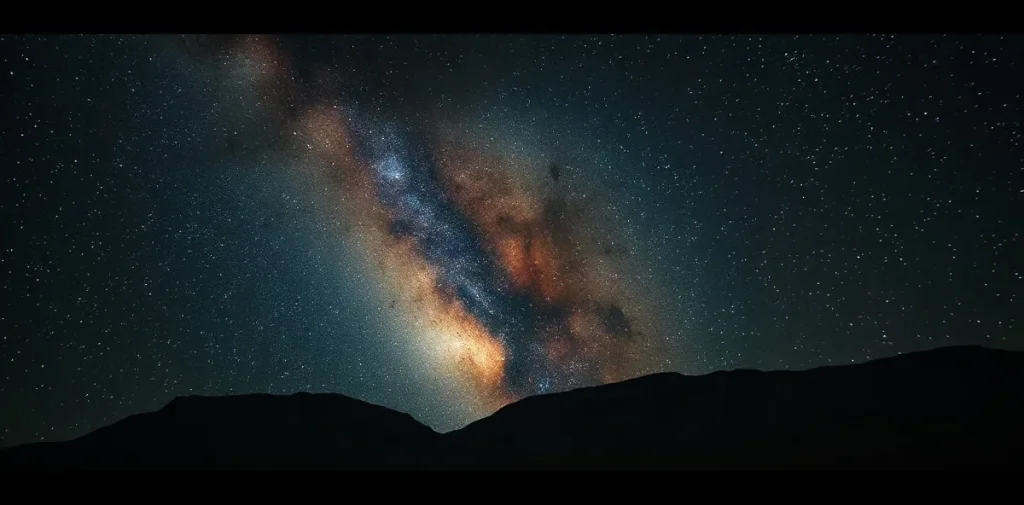
Stars are luminous celestial bodies, while galaxies are vast systems of stars, gas, and dust.
To create a “Stars and Galaxies” table, compare what these objects are and how they are related. Stars are part of galaxies, while galaxies themselves bring together many objects.
| Object or catalog | Type or contents | What to record |
|---|---|---|
| Ptolemy’s Almagest | Historical catalog | 1025 stars and nebulae |
| Gliese Catalog | Nearby stars | Includes confirmed and unconfirmed objects |
| Alfonsine Tables | Information about celestial objects | Supplemented with new sources and corrections |
- 1025 stars and nebulae objects described in Ptolemy’s Almagest
- 1979 year the Gliese Catalog was published
- 16 777 216 colors possible colors for a pixel with the RGB encoding described
How can you tell a star, a galaxy, and a nebula apart?
You can avoid confusing a star, a galaxy, and a nebula by entering only objects explicitly named in the text and listing each one’s type separately.
In astronomical catalogs, stars, nebulae, and galaxies belong to different types of celestial objects. An object’s name alone is therefore not a reason to assign it to another category.
- Star: use this type only if the text explicitly calls the object a star.
- Galaxy: write “galaxy” if that is how the text identifies the object.
- Nebula: keep it as a separate type; do not list a nebula as a star or galaxy.
How to format the table
Add a separate “Object type” column and enter the type in the same row as the name. This lets readers see how the objects differ without having to compare neighboring rows.
If the text mentions an object but does not identify its type, do not infer a category from its name or context. Leave the cell blank or write “not specified.”
Which columns help you accurately transfer information from the text?
For a school table about stars and galaxies, use three columns: “Object type,” “Name,” and “Characteristic.”
Enter one object per row. In the “Object type” column, state what the text describes: a star, a galaxy, or a nebula. In “Name,” enter the name given in the text, and in “Characteristic,” include only the information provided there. Do not add properties that the text does not mention.
- “Object type” helps distinguish stars from nebulae, even when the text mentions them together.
- “Name” links the information to a specific object or catalog.
- “Characteristic” contains a description that directly applies to the object in that row.
If the text about the Almagest mentions stars and nebulae, enter them as two types of objects rather than combining them into one category. Read the whole text first: this makes it easier to see which object each description refers to and prevents you from assigning a characteristic of stars to nebulae.
Why shouldn’t information about image encoding go in an astronomy table?
Information about image encoding does not belong in a table about stars and galaxies: it describes a digital file and its color, not the properties of celestial objects.
At a color depth of 32 bits per pixel, an image measuring 1310720 pixels requires 41943040 bits of video memory, or 5242880 bytes. This calculation concerns image storage; it tells you nothing about a star or galaxy.
In RGB, each component can take a value from 0 to 255, and an image pixel can be one of 16 777 216 colors. These are color-encoding parameters, not characteristics of an astronomical object.
How to separate the information
- Check what each number refers to: include only information about stars and galaxies in the table.
- If the assignment separately asks you to analyze an image, create a separate table for it. Do not mix information about pixels and video memory with the characteristics of celestial objects.
How can you check the table against astronomical catalogs?
Check the table against astronomical catalogs by matching each object and its description to a catalog that fits the assignment. An astronomical catalog is a list of celestial objects grouped by type or another criterion; it may include stars, nebulae, and galaxies.
- Ptolemy’s Almagest is a historical list describing 1025 stars and nebulae. Use it if the table asks you to identify early catalogs of celestial objects.
- The Gliese Catalog was published in 1979 and includes confirmed and unconfirmed nearby stars. Take both statuses into account when checking entries: being listed in the catalog does not, by itself, mean a star has been confirmed.
- The Alfonsine Tables supplemented earlier information and corrected inaccuracies. When comparing them with other lists, clarify exactly which information needs to be checked.
Before filling in the table, determine what the assignment asks you to compare: an object’s type, its status, or the history of a catalog. Then check that your chosen list matches that criterion, and do not confuse a star catalog with historical tables that corrected earlier information.
When is a standard table format not suitable?
A standard table format is not suitable when the text compares stars and galaxies using several shared characteristics, or when the teacher has already provided column headings: adapt the structure to those requirements without going beyond the text.
- Several shared characteristics. If the text separately specifies, for example, the type and method of detection of objects, give each its own column. A general “Characteristic” column would obscure exactly which feature is being compared.
- No name or type. Do not fill in missing information from memory: if the text does not give a star’s name or a galaxy’s type, leave the relevant cell blank or indicate that the information is not provided.
- The catalog uses a different classification. Astronomical catalogs may group objects by type, morphology, origin, or method of detection. For example, the Gliese Catalog covers nearby stars, but its criteria may not match the question in a school assignment.
- Headings are already provided. Use the teacher’s columns, even if your own format seems more convenient: the assignment requirements take priority over your preferred layout.
Before filling in the table, check each column against the text: it should correspond to specific information, not a guess about a celestial object.
Frequently asked questions
What should I write in a table about stars and galaxies?
Can I add information from the Gliese Catalog to the table?
How is the Almagest useful for this kind of table?
What should I do if the text does not give an object’s characteristics?
Sources
- Astromyth v.2.0 — “Catalogs of the Starry Sky”
- elementy.ru — “Star Islands: Galaxies”
- starwalk.space — “Astronomical Catalogs: From Ancient Books to”
- apps.apple.com — “Star Walk 2 Plus: Starry Sky App — App Store”
- rgkript.ru — “Appendix 2”