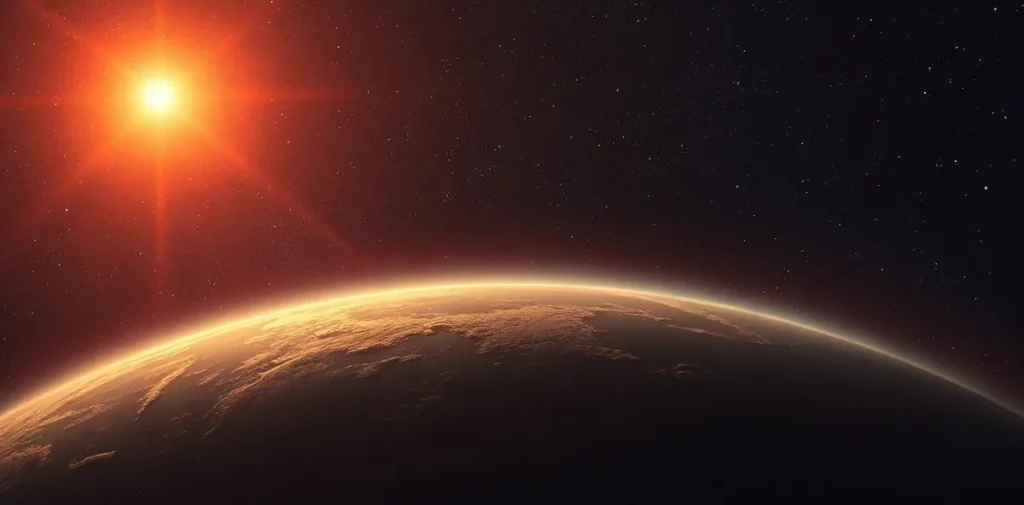
During a total lunar eclipse, the Moon turns red because Earth’s atmosphere lets mostly red light reach it while scattering blue light. Sunlight passes through Earth’s atmosphere, bends, and enters the planet’s shadow, coloring the lunar surface copper and crimson.
The Moon does not emit this light itself: it reflects sunlight, so its color during an eclipse depends on which light reaches it through Earth’s atmosphere. This creates the effect known as a “blood moon”; let’s look at how the positions of the Sun, Earth, and Moon produce this spectacle.
| Type | Moon’s position | What you see |
|---|---|---|
| Total | Entire disk in the umbra | May appear red |
| Partial | Part of the disk in the umbra | A dark arc on the Moon |
| Penumbral | Disk in the penumbra | Subtle dimming |
- 3 main types of lunar eclipse: total, partial, and penumbral
- 1 full Moon is needed for Earth to line up between the Sun and the Moon
- 0 special filters are needed to safely observe a lunar eclipse
How do the Sun, Earth, and Moon line up during an eclipse?
During a lunar eclipse, Earth lies between the Sun and the Moon, with all three bodies positioned almost in a straight line; that is why an eclipse can occur only at full Moon. The Moon passes through Earth’s shadow, which consists of an outer penumbra and a central dark region called the umbra.
Penumbra and umbra
In the penumbra, Earth blocks only some of the sunlight from reaching the Moon, so the lunar disk dims only slightly. When the Moon enters the umbra, its surface lies in the central part of Earth’s shadow: if only part of the disk crosses the umbra, the eclipse is partial; if the entire disk enters it, the eclipse is total.
An eclipse does not occur at every full Moon because the Moon’s orbit is tilted relative to the plane of Earth’s orbit. As a result, the Sun, Earth, and Moon usually miss an exact alignment: the lunar disk passes above or below Earth’s shadow. For an eclipse to occur, the full Moon must coincide with the Moon passing through the region where its orbit crosses that plane.
Why does the Moon turn red during a total eclipse?
During a total lunar eclipse, the Moon turns red because Earth’s atmosphere bends some sunlight toward it and scatters short-wavelength blue light more strongly than red and orange light. Earth blocks direct sunlight, but light traveling along Earth’s atmosphere bends around its edge and reaches the lunar shadow.
The red hue comes from the light of Earth’s sunrises and sunsets: as it travels through the atmosphere, blue light scatters in all directions, making it easier for red and orange rays to reach the Moon. In effect, during a total eclipse, the lunar disk is lit by sunlight that has passed tangentially through Earth’s atmosphere, rather than by direct sunlight.
The Moon’s brightness and hue during an eclipse vary with conditions in Earth’s atmosphere. Clouds, dust, and aerosols affect how much light reaches the lunar disk, so it may look bright red, coppery, or dim.
When and where can you watch a lunar eclipse?
Check your local time
You can watch a lunar eclipse while the Moon is above the horizon in your city: check an astronomical calendar in advance for the exact date and local time. The same eclipse may be visible differently from different cities—for example, the Moon may rise after the eclipse has begun or set before it ends. To see the entire sequence, choose a spot with an unobstructed view of the sky for several hours.
Choose a clear horizon
To watch the Moon rise, you need an open eastern horizon: the Moon appears in the east, but its exact direction and altitude change through the night. Check in advance that buildings, trees, or terrain will not block your view, and take the cloud forecast into account.
- The full sequence: a spot with a wide view of the sky for several hours, not a brief gap between buildings.
- Penumbral dimming: choose a less light-polluted location, where the subtle change in brightness is easier to notice.
- Total eclipse: the Moon’s red disk is visible even in a less dark sky, as long as clouds do not block it.
Can you see an eclipse without a telescope?
Yes, you can see a lunar eclipse with the naked eye: all you need is an open patch of sky and a clear view of the Moon. No special filters are needed—it is safe to look at the Moon during an eclipse, unlike the Sun.
Binoculars help you see the edge of Earth’s shadow on the lunar surface and details of the lunar maria, but they are not essential for watching the eclipse. A telescope does not make the eclipse brighter, either: at high magnification, it is harder to keep the entire lunar disk in view, so a telescope may be less convenient for a general view than watching without optics.
When might you not be able to see an eclipse, and what mistakes can get in the way?
Visibility limits
You will not be able to see a lunar eclipse if the Moon is below the horizon or hidden by clouds at the time; choosing a viewing spot in advance does not guarantee a clear view. Even the total phase cannot change these conditions: the eclipse still happens, but the observer cannot see it.
- Moon below the horizon: the disk is hidden from an observer at that location, including during a total eclipse.
- Clouds: dense clouds can hide the Moon completely, so an open horizon alone does not guarantee visibility.
A penumbral eclipse is harder to notice than a partial or total one: the disk’s dimming can be subtle and gradual. If the Moon has not entered the umbra—the darkest part of Earth’s shadow—do not expect the sharp red coloring characteristic of the total phase.
The Moon’s low position above the horizon does not, by itself, mean an eclipse is happening. Its light passes through a thicker layer of atmosphere, so the disk may look warmer in color; to check, distinguish this color change from the dimming caused by Earth’s shadow.
How is a total eclipse different from a partial or penumbral eclipse?
A total eclipse differs from a partial or penumbral eclipse in how deeply the Moon enters Earth’s shadow: during a total eclipse, the entire disk is in the umbra; during a partial eclipse, only part of it is; and during a penumbral eclipse, the Moon passes only through the penumbra. The disk’s position relative to the two regions of shadow determines how noticeable the eclipse is.
- Total: the entire lunar disk passes through the umbra—the central, darkest part of Earth’s shadow. In suitable atmospheric conditions, the Moon takes on a copper-red hue.
- Partial: only part of the disk enters the umbra, so a dark arc appears across it; the rest of the Moon remains outside the umbra.
- Penumbral: the Moon passes only through the penumbra, the outer region of Earth’s shadow. The dimming is usually subtle and may not be immediately noticeable.
You can tell the types of eclipse apart by comparing the brightness of different parts of the lunar disk. The edge of the umbra looks sharper and more distinct than the gradual transition into the penumbra: during a partial eclipse, a dark arc is visible, while during a penumbral eclipse the disk only loses a little brightness. During a total eclipse, the umbra covers the entire Moon, and its color depends on conditions in Earth’s atmosphere.
Frequently asked questions
Do you need special glasses for a lunar eclipse?
Why isn’t the Moon red during every eclipse?
Can you see an eclipse from a city?
Why don’t eclipse dates coincide with every full Moon?
