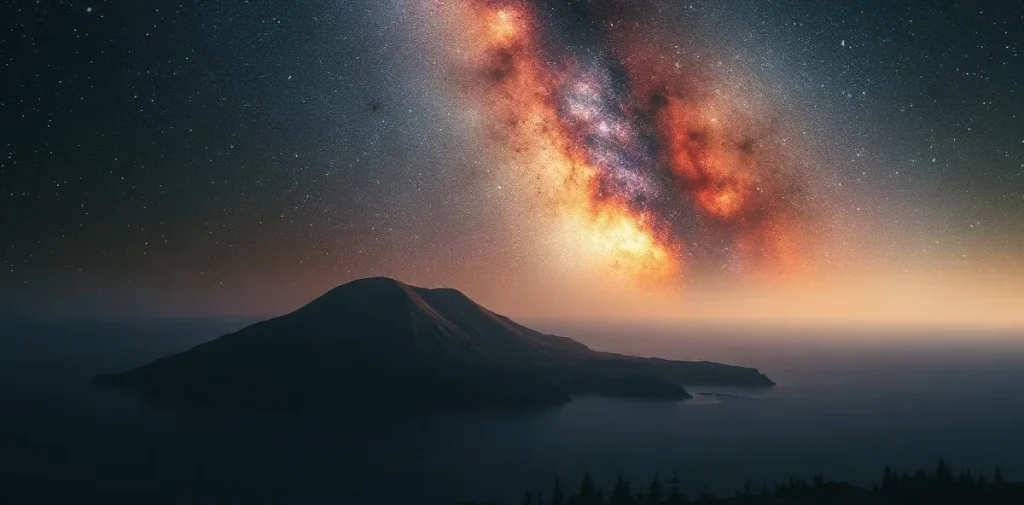
The best places to look for the northern lights are dark locations at northern latitudes, on clear nights and away from city lights. They are most often seen in autumn and winter, but exactly when they will appear cannot be predicted.
The aurora occurs when charged particles interact with Earth’s atmosphere. So even in a suitable location, the lights may not appear, and clouds can hide them from view.
In this article, we’ll look at where to go, when to head out, and what to check before your trip.
| Criterion | What to check | How it affects viewing |
|---|---|---|
| Geomagnetic activity | KP index in the app | Helps assess the likelihood of auroras |
| Cloud cover | Forecast for your chosen location | Thick clouds block the sky |
| Light pollution | Distance from city lights | A dark location improves visibility |
| Season and time | September — March; 21:00–02:00 | A long, dark night gives you more time to wait |
- ~ 64°-61° с.ш. approximate latitude range for the aurora forecast on auroralights.ru
- с 5 по 8 ноября 2026 года dates of the trip to Teriberka offered by the PIK outdoor club
- 55 000 ₽ cost of this trip
How does the solar wind create the northern lights?
The northern lights occur when charged particles from the solar wind, guided by Earth’s magnetic field toward the polar regions, transfer energy to gases in the upper atmosphere.
Earth’s magnetic field interacts with the stream of particles and directs them mainly toward the magnetic poles. That is why auroras are most often seen at high latitudes. The northern lights are the glow near the North Magnetic Pole; a similar phenomenon in the Southern Hemisphere is called the southern lights.
Latitude and the chance of seeing the aurora
Auroralights.ru gives an approximate latitude range for its northern-lights forecast: ~ 64°-61° с.ш. This is a forecast range, not a guarantee that the aurora will be visible in any particular location: it occurs in the upper atmosphere, and clouds or city light pollution can obstruct the view.
Where in Russia can you look for the aurora, and how do you choose a latitude?
In Russia, people most often look for the northern lights on the Kola Peninsula and in Murmansk Oblast; choose a latitude for viewing based on the forecast and how far the location is from urban light pollution.
- Kola Peninsula: the main destinations are Murmansk, Teriberka, and the Khibiny Mountains.
- Other regions: people also look for the aurora in Karelia, Arkhangelsk Oblast, the Khanty-Mansi Autonomous Okrug, and Yamal.
- Latitude guide: auroralights.ru gives a range of ~ 64°-61° с.ш. for its northern-lights forecast.
On auroralights.ru, the status was listed as “Quiet” until 30.10.2026, 18:31. This is a guide for checking the forecast, not a guarantee that the aurora will be visible in any particular location.
Choose a location away from city lights
The Solovetsky Islands and areas far from city lights may be suitable for viewing: light pollution makes faint auroras harder to see. Choose a spot beyond illuminated streets and check the forecast for the specific area you plan to visit.
When should you go, and how long should you wait?
The northern lights in Russia can be seen from late August to early April; the most suitable period is September through March. Plan to wait once you arrive: the aurora may not appear right away.
A good window for viewing is 21:00 to 02:00, especially from 23:00 to midnight. This is a suggested time to be out under the open sky, not a guarantee that the aurora will be visible that night.
A trip to Teriberka
The PIK outdoor club offered a trip to Teriberka from 5 to 8 November 2026: 4 days, 20 km, at a cost of 55 000 ₽. This route is one ready-made option for a trip during aurora season; exactly when the lights will appear remains unpredictable.
Allow time to wait and be prepared to spend several hours at your chosen spot.
How do you read an app and the northern-lights forecast?
To assess your chances of seeing the northern lights, check the KP index and aurora probability in the “My Aurora Forecast” app, then check the cloud cover over your viewing location separately.
The KP index shows the level of geomagnetic activity and helps you understand how favorable conditions are for auroras. But a high index does not mean the lights will be visible from your chosen location: clouds may cover the sky.
What to check before heading out
- Activity: check the current KP index and aurora probability in the “My Aurora Forecast” app.
- Cloud cover: check the forecast for the viewing area itself, not just the nearest city. Even with favorable geomagnetic activity, thick cloud cover will obstruct the view.
- Location and timing: set a specific destination before setting out, then update the forecast closer to evening. Conditions can change, so don’t rely on a check you made well in advance.
Make your decision based on all the factors together: the KP index indicates activity, while the cloud forecast shows whether the sky will be visible over your chosen location.
Why doesn’t a high forecast guarantee the aurora?
A high forecast for geomagnetic activity does not guarantee you’ll see the northern lights: clouds, city light pollution, or a brief, faint display can all make them impossible to spot.
Don’t mistake likelihood for a promise
A forecast describes activity, not visibility from a specific location. Auroralights.ru listed the status as “Quiet” until 30.10.2026, 18:31; whatever the status, clear skies are needed for viewing.
- Cloud cover: thick clouds hide the aurora, even when geomagnetic activity is high.
- City light pollution: city lights reduce contrast; choose a dark location with an unobstructed view.
- Variability: forecasts change, and the aurora may be faint or brief.
Before heading out, check both the activity forecast and the cloud cover at your chosen location. If the sky is overcast, a high reading alone won’t make the aurora visible.
Allow extra time and be prepared to change locations: viewing is best where the horizon is open and city lights don’t interfere.
Frequently asked questions
Which months are best for looking for the northern lights in Russia?
Where can you look for the aurora in Murmansk Oblast?
What does the KP index in the app mean?
What time should you head out to watch?
Sources
- moya-planeta.ru — “The Northern Lights: What They Are, What Causes Them, and How to See Them”
- What Are the Northern Lights? — “The Northern Lights: What Causes Them and How to See Them”
- astrovert.ru — “When and Where to See the Northern Lights in Russia”
- RussiaDiscovery — “Where to See the Northern Lights in Russia 2026–2027: When and Where to Go, Tours”
- apps.apple.com — “My Aurora Forecast App — App Store”