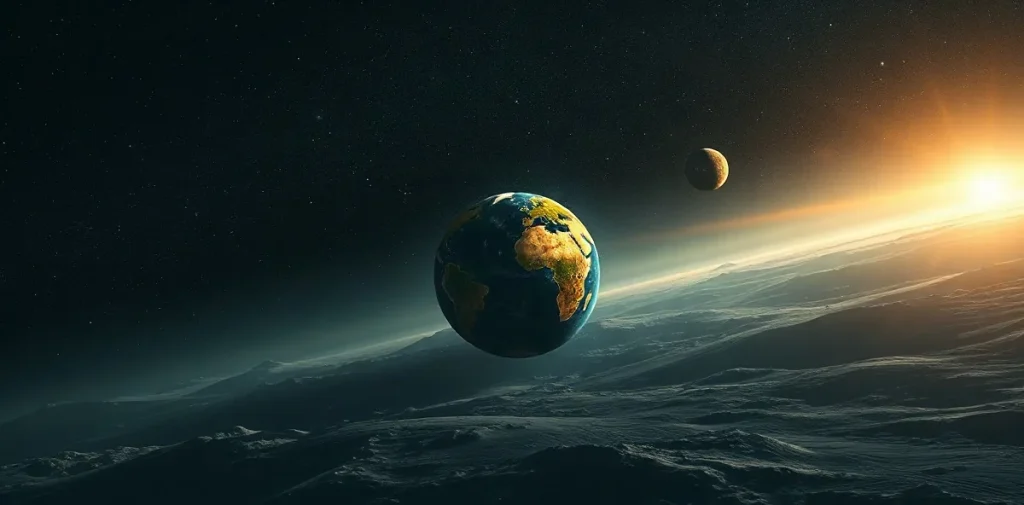
The old geocentric model placed Earth at the center of the world, with the Sun, planets, and stars thought to move around it. The apparent motion of celestial bodies was explained by combining their circular paths with additional circular movements, which helped bring the model into line with observations.
This Earth-centered model was more than a guess: it provided a coherent account of the familiar sky and made it possible to predict the positions of celestial objects. Let’s look at how the system worked and why its explanations grew more complex; a comparison with the heliocentric picture appears in the article “The Solar System Model: Geocentric and Heliocentric Views of the Universe.”
| Criterion | Geocentric model | Heliocentric model |
|---|---|---|
| Center of the system | Stationary Earth | Sun |
| Earth’s motion | Earth is stationary | Earth orbits the Sun |
| Retrograde motion of planets | Represented by loops using epicycles | Explained by the relative motion of the planets |
| Historical role | Foundation of ancient and medieval astronomy | Alternative to the geocentric system |
- 1 center — stationary Earth the basis of the geocentric view of the universe
- 1 center — the Sun the basis of the heliocentric view of the universe
- 2 models views of the universe being compared: geocentric and heliocentric
What did the old Earth-centered model mean?
The geocentric view of the universe placed the stationary Earth at the common center, around which celestial bodies were believed to revolve. The idea emerged in ancient Greece and became the foundation of ancient and medieval astronomy and cosmology. Geocentrism was not a single, unchanging model, but a family of ideas: its different versions described the arrangement of celestial motions in different ways while keeping Earth at the center.
The geocentric model had to explain not only the daily motion of celestial objects across the sky, but also the peculiar movements of the planets. Mars, for example, sometimes appears to move backward against the stars—a phenomenon known as retrograde motion. Geocentric models used complex constructions, including epicycles, to describe such observations: small circular motions superimposed on the main orbit around Earth.
How the heliocentric system differed
The historical alternative to geocentrism was the heliocentric system, associated with Nicolaus Copernicus: in this model, Earth and the other planets orbit the Sun. On this account, Mars’s retrograde motion is not an actual reversal of the planet’s direction, but an apparent effect that occurs when Earth overtakes Mars in its orbit. The main difference between the models was which object they placed at the center of the overall picture: Earth or the Sun.
Why did Earth seem to be a stationary center?
Earth seemed to be a stationary center because its motion is imperceptible in everyday observations, while the Sun and stars appear to change position in the sky. The geocentric model turned this impression into a picture of the universe: Earth remained at the center, and celestial bodies were thought to move around it. This view was widespread in antiquity and the Middle Ages.
How the motion of the planets was explained
Planets usually shift against the background of stars in one direction, but at times Mars seems to reverse course and trace a loop. The geocentric system kept Earth stationary, but used additional circular motions of the planet—epicycles—to describe this retrograde motion.
The heliocentric view explained the apparent loop differently: Earth, moving in an orbit closer to the Sun, overtakes Mars, making it temporarily appear to move backward against the background of distant stars. The geocentric model was therefore not simply a rejection of observations: it could describe the positions of celestial objects while keeping Earth in its familiar central position, until it was replaced by a system with the Sun at the center and the planets moving around it.
How did epicycles explain the retrograde motion of planets?
A small circle within a larger scheme
Epicycles explained retrograde motion by having a planet travel along a small circle while the center of that circle moved around stationary Earth. In the geocentric model, combining the two motions made it possible to represent a loop: against the background of stars, the planet seemed to change direction for a while before continuing along its usual apparent path.
The heliocentric model explains the same apparent loop through the planets’ orbits around the Sun. For example, when Earth, moving in an orbit closer to the Sun, overtakes Mars, Mars appears for a while to move in the opposite direction against the background of distant stars. Mars itself does not turn around or start flying backward: what changes is the planet’s apparent position as seen from Earth.
- Geocentric explanation: Mars’s retrograde loop is produced by its motion along an epicycle and the movement of that circle’s center around Earth.
- Heliocentric explanation: Mars’s apparent reversal occurs when Earth overtakes it in its orbit around the Sun.
In short, an epicycle was a geometric way to describe the observed loop, while the heliocentric model linked it to the relative motion of Earth and Mars. In both cases, the subject is how a planet’s apparent position changes against the stars.
What did the geocentric model explain well, and what did it explain poorly?
The geocentric model showed the apparent order of celestial motions well, but was less successful at explaining them when planets changed direction in the sky. It treated Earth as a stationary center and described the motions of celestial bodies relative to it; epicycles could represent retrograde loops, but they made the model more complicated.
The cost of the explanation: extra circles
An epicycle is the circular motion of a planet around a point that itself moves along a larger circle around Earth. This scheme could represent why Mars seemed to move backward among the stars for a while before resuming its usual direction. But unusual movements required adding more circles, turning an intuitive description into an increasingly complex construction.
- Geocentric system: Earth is stationary, and Mars’s retrograde loop is represented by an additional circular motion—an epicycle.
- Heliocentric system: Earth and Mars orbit the Sun; retrograde motion is an apparent effect of their movement, rather than a separate loop around Earth.
The heliocentric system not only explained changes in the apparent direction of the planets without such a separate geocentric loop, but also helped establish the order of the celestial bodies. The geocentric model’s advantage lay in its simple starting picture—Earth at the center—whereas the heliocentric model better connected the observed movements of the planets with their motion around the Sun.
How does the geocentric view differ from the heliocentric one?
The geocentric view places stationary Earth at the center, while the heliocentric view puts the Sun at the center and considers Earth one of the planets orbiting it. The key difference is not simply the location of the center: it changes how the apparent motion of celestial bodies is explained. The geocentric system remained the foundation of astronomy for a long time, while the heliocentric system offered a different way to describe planetary motion.
How retrograde motion is explained
In the geocentric model, Mars’s retrograde motion was represented as a loop against the background of stars; additional circular motions—epicycles—were used to describe such observations. In the heliocentric view, the loop does not mean that the planet actually reverses direction and travels backward along its orbit.
The heliocentric model explains apparent retrograde motion through the relative motion of Earth and the other planets: when Earth overtakes Mars, its direction of motion against the background of distant stars seems to reverse for a while. The observed loop is therefore an effect of the observer moving with Earth, not a separate maneuver by Mars. A fuller comparison of the two views of the universe appears in “The Solar System Model: Geocentric and Heliocentric Views of the Universe.”
Why did the old model give way to the heliocentric one?
The heliocentric system displaced the geocentric one because it explained planetary motion with a single overall scheme: Earth and the other planets orbit the Sun instead of moving along complex loops around a stationary Earth. This approach changed not only the description of celestial paths, but also Earth’s place in the structure of the universe.
Why retrograde motion became easier to understand
In the geocentric view, a planet’s retrograde motion was represented as a separate loop along its path around Earth. The heliocentric model explains the same apparent effect through the motion of Earth and the other planets: when Earth overtakes Mars in its orbit, Mars seems to move backward against the background of distant stars for a while. The observed phenomenon does not disappear—only its cause is explained differently.
The shift to heliocentrism meant that Earth became one of the planets rather than the stationary center of the cosmos. In this view, the retrograde motions of Mars and other planets follow from their relative motion around the Sun; in the geocentric model, they had to be represented by additional loops. The important advantage was not that observations were discarded, but that they gained a more unified explanation.
Frequently asked questions
What is the geocentric model?
Why did the geocentric model need epicycles?
Why does Mars sometimes appear to move backward?
Is the geocentric model completely wrong?
Sources
- zaochnik-com.com — “The Heliocentric System of the World”
- bguor.ru — “1. Geocentric and Heliocentric Systems”
- ru.ruwiki.ru — “The Heliocentric System of the World”
- galactic.name — “The Heliocentric System of the World — Astronomical Portal”
