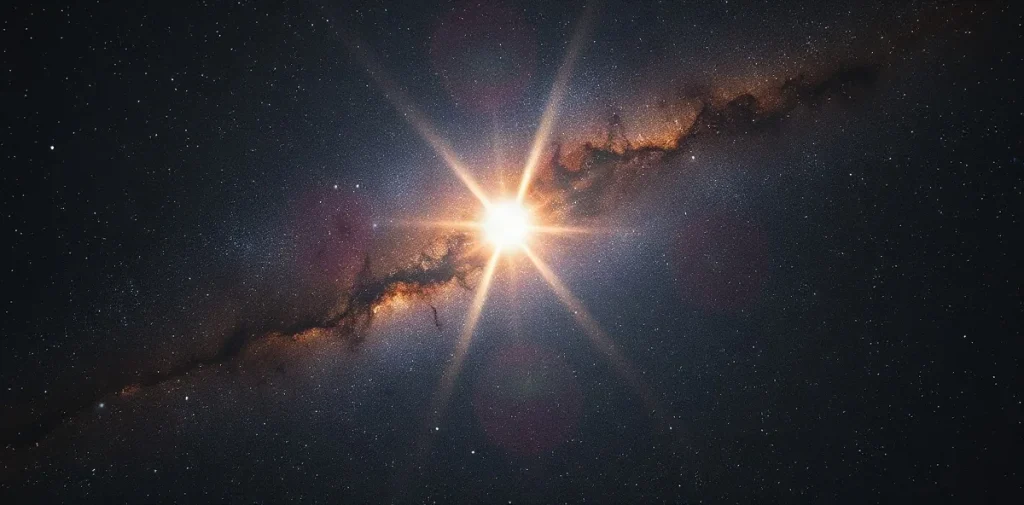
Galaxies and stars are parts of a Universe bound together in a vast cosmic web: galaxies gather into clusters and long filaments, with immense voids between them. Stars are part of galaxies, while gravity helps shape the large-scale structure of the cosmos.
To see how individual stars and galaxies combine to form a picture of the Universe, let’s trace the path from stellar systems to galaxy clusters and the filaments of the cosmic web. The fundamental connections between the cosmos’s major objects are explored in more detail in our article “Stars and Galaxies: How the Universe’s Major Objects Are Structured and Connected.”
| Method | What is measured | What it helps us learn |
|---|---|---|
| Image | Distribution of light | The object’s shape and structure |
| Spectrum | Light across wavelengths | Chemical elements and motion |
| Parallax | Apparent shift of a nearby star | Distance to nearby stars |
| Redshift | Shift in spectral lines | A galaxy’s recession within the framework of a cosmological model |
- 1 example star: the Sun
- 3 levels of cosmic hierarchy in a short sequence: star, galaxy, group or cluster
- 2 main ways of describing observations in this article: image and spectrum
How does starlight reveal a star’s properties?
Starlight reveals a star’s temperature, chemical composition, and distance through its spectrum, color, and apparent shift in position. The Sun is a main-sequence star: in its core, hydrogen is converted into helium by nuclear fusion, releasing energy.
Spectrum, color, and distance
A star’s spectrum is the distribution of its light across wavelengths. It contains dark absorption lines: different chemical elements leave distinctive signatures that astronomers use to identify a star’s composition. Blue indicates a hotter surface than red, but color alone cannot determine a star’s distance precisely.
The distance to a nearby star can be found using parallax: compare its apparent position against more distant objects when Earth is at different points in its orbit. This shift helps distinguish the star’s actual motion from a change in viewing angle. Together, spectral lines, color, and parallax provide different information—composition, surface temperature, and distance—without treating one measurement as a substitute for another.
What makes stars part of a galaxy?
Stars become part of a galaxy when they form a gravitationally bound system with gas, dust, and dark matter, moving within a shared gravitational field. A galaxy is therefore more than a collection of stars: its structure also includes interstellar matter and invisible dark matter.
Disk, bulge, and halo
The Milky Way is a barred spiral galaxy: the Sun is in its disk, not at its center. The disk contains interstellar gas—the raw material for new stars—while closer to the center, the bar and bulge, the galaxy’s central concentration of stars, are prominent. Thus, the disk, central region, and surrounding halo are different parts of one system bound by gravity.
Galaxies are studied through images and spectra: images help distinguish their shape and structure, while spectra are used to investigate the composition and motion of matter. In the Milky Way’s case, this lets astronomers examine the spiral disk, central bar, and bulge separately, rather than reducing the entire galaxy to the bright stars visible in an image.
How do galaxies form large-scale structure?
Galaxies form large-scale structure by gathering into groups and clusters, which gravity links into filaments and nodes of the cosmic web. Vast regions with less matter stretch between these dense areas. Galaxies are therefore not distributed uniformly throughout the Universe: they are more common where gravity draws matter together.
From a star to the cosmic web
The cosmic web is not a continuous network of galaxies, but a structure of filaments and nodes separated by less dense regions. A group and a cluster are different levels of organization: individual galaxies belong to groups or clusters, and these systems are themselves connected to larger structures.
The journey from a star to the cosmic web spans four scales: a star lies in a galaxy; galaxies gather into a group or cluster; groups and clusters belong to large-scale structure. In this way, gravity connects objects of different sizes—from stars within galaxies to the filaments along which matter is distributed.
What do astronomers learn from images and spectra?
Light and spectrum
Astronomers use images to study galaxy shapes and the distribution of their light, and spectra to investigate the chemical composition and motion of sources. An image may reveal spiral arms or a bright core, but on its own, without additional observations, it does not always show an object’s composition or distance.
Spectroscopy separates light into wavelengths; spectral lines help identify chemical elements and measure a source’s motion relative to the observer. When the lines shift toward the red end of the spectrum, astronomers use this redshift to estimate how far away a galaxy is. Converting such a shift into a distance depends on the cosmological model adopted.
From observations to conclusions
Comparing an image with a spectrum helps distinguish the galaxy’s directly visible structure from conclusions about its composition and dynamics. When interpreting the data, astronomers consider what each type of observation can tell them:
- Image: the galaxy’s shape and the distribution of light.
- Spectrum: spectral lines used to infer the source’s chemical elements and motion.
- Redshift: the observed shift in spectral lines, used to estimate recession within the framework of a cosmological model.
When do observations fail to give a clear-cut picture?
Observations do not always give a clear-cut picture because a telescope records light in a selected range rather than every property of a galaxy directly. Interstellar dust absorbs visible light, so star-forming regions may be hidden in optical images; observations in another wavelength range can reveal what is invisible in those images.
At great distances, galaxies appear fainter and more compact, and the results depend on the telescope’s sensitivity and the wavelength range observed. An object’s absence from an image therefore does not prove that it is not there: it may be too faint for a particular instrument or emit primarily outside the selected range.
What measurements actually show
Redshift—a shift in light toward longer wavelengths—is not, by itself, a photograph of a galaxy’s distance: converting it into a cosmological distance requires a model of the Universe’s expansion. Finally, visible starlight does not directly reveal the distribution of dark matter, so it should not be conflated with a galaxy’s total mass: these are different observable properties that require different methods of estimation.
How can we connect an individual star to the structure of the Universe?
We can connect an individual star to the structure of the Universe by tracing a path from its spectrum to its galaxy, and then to groups and clusters of galaxies. A spectrum reveals a star’s temperature and the chemical elements in its atmosphere, but it does not describe the entire galaxy on its own: to do that, we need to take into account the distribution of other stars and gas.
From a galaxy’s components to large structures
Stars and gas in a galactic disk help us investigate its composition and structure; the bulge is the galaxy’s central region; the halo is the outer region surrounding the disk and bulge. Comparing these components answers different questions about a galaxy’s structure, so the properties of one star cannot automatically be taken as characteristic of the entire system.
Groups and clusters of galaxies show us the next scale up: individual galaxies belong to larger associations that can be compared with one another. This lets us trace the connection from a star’s spectrum, through its galactic environment, to the structures of the cosmic web. For more on how cosmic objects are connected, see our article “Stars and Galaxies: How the Universe’s Major Objects Are Structured and Connected.”
Frequently Asked Questions
How is a star different from a galaxy?
Where is the Sun?
What is the cosmic web?
Can a galaxy’s distance be determined by its color?
Key Takeaways
- A star’s spectrum reveals its temperature and chemical composition.
- The Milky Way is a barred spiral galaxy, and the Sun is in its disk.
- Galaxies are linked into groups, clusters, and the filaments of the cosmic web.
- Redshift helps astronomers study how far galaxies are receding, but its interpretation depends on the cosmological model.
