Updated: September 28, 2026
Introduction: Why the Night Sky Is Brighter in Cities
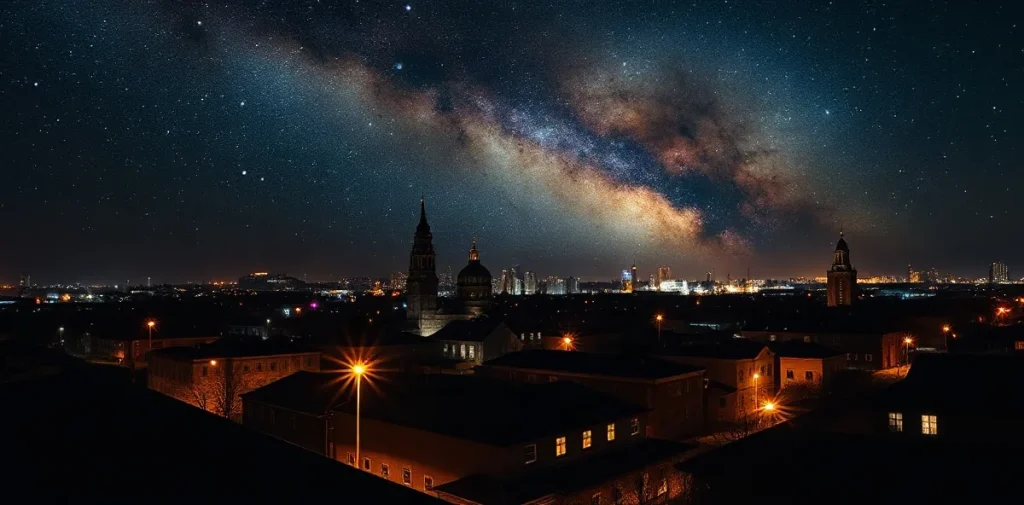
Many amateur and professional astronomers note that the night sky near large cities appears unnaturally bright. This is due to a phenomenon known as light pollution — excessive artificial lighting scattered in the atmosphere, creating a background glow that obscures stars and galaxies. According to the International Astronomical Union (IAU) in 2026, over 80% of Earth’s population lives in areas where light pollution exceeds 20 µcd/m² (microcandelas per square meter), significantly degrading the quality of astronomical observations.
Causes of Light Pollution in Cities
Main Sources and Their Characteristics
The primary sources of light pollution in cities are:
- Street lighting: In Russia, as of 2025, about 65% of street lamps still use outdated high-pressure sodium bulbs, which emit a broad spectrum of light that contributes to scattering.
- Billboards and building facades: According to the Moscow Lighting Committee, illuminated signs can increase the local sky brightness up to 50 µcd/m² within a 2 km radius.
- Vehicle headlights: Modern LED headlights, used in 70% of new vehicles in Russia in 2026, emit more intense, focused light, raising glare levels.
Combined, these sources create a bright light background that reflects and scatters in the lower atmosphere layers, especially under cloudy or humid conditions.
How Light Pollution Affects Astronomical Observations
Loss of Contrast and Detail
Light pollution raises the sky’s background brightness, reducing contrast for faint objects. According to a 2024 study by the Space Research Institute of the Russian Academy of Sciences (IKI), urban background glow can exceed natural night sky brightness by a factor of 10, making objects with surface brightness below 21.5 mag/arcsec² impossible to observe.
Additionally, the background light increases noise when using CCD cameras in amateur telescopes — for example, the popular Celestron NexStar 8SE shows a 30% drop in signal-to-noise ratio under city conditions compared to dark sites.
How Urban Observers Combat Light Pollution Effects
Technical and Organizational Measures
Astronomers use the following methods to reduce light pollution impact:
- Using narrowband filters: Filters like H-alpha (e.g., Baader H-alpha 7nm) isolate specific wavelengths, cutting background illumination by up to 60%.
- Choosing observation sites: Suburban observatories, such as the Moscow Astronomical Observatory, are located at least 30 km from city centers, reducing light pollution levels to about 5 µcd/m².
- Software utilization: Modern programs like Stellarium Plus 2026 allow modeling of light pollution levels and optimizing observation times.
Legislation and Standards Against Light Pollution
Russian and International Initiatives
In Russia, the first regional regulations addressing light pollution were adopted in 2023, including the GOST R 58957-2020 standard, which limits light flux and directionality of street lamps. Yekaterinburg has introduced a standard limiting outdoor lighting brightness to no more than 1000 lumens per fixture.
Internationally, the Dark Sky Association actively promotes «dark sky» standards (Dark Sky Certification), which by 2026 have been awarded to over 150 communities worldwide, including the small Italian town of Villa Romana with a population of 3,500.
Comparison of Light Pollution Levels Across Regions
Sky Brightness Table in µcd/m² by City
| City | Light Pollution Level (µcd/m²) | Notes |
|---|---|---|
| Moscow | 45 | High level, active street lighting |
| New York | 40 | Many billboards, LED lighting |
| Villa Romana (Italy) | 2 | Dark Sky standard, low lighting |
| Tomsk | 15 | Intermediate level, partial urbanization |
| Atacama Desert (Chile) | 0.1 | One of the darkest places on Earth |
Frequently Asked Questions
Is it possible to completely eliminate light pollution in cities?
Which telescopes are best suited for urban observations?
How can one measure the light pollution level at a specific location?
Does weather affect light pollution?
Key Takeaways
- Light pollution increases urban night sky brightness on average 10 times above natural levels.
- Main sources include street lighting, advertising signs, and vehicle headlights.
- Modern filters and choosing sites away from city centers help mitigate pollution effects.
- Legislative regulation and lighting standardization are growing in Russia and worldwide to preserve night sky quality.
- Light pollution can be measured using SQM devices and satellite data.
Conclusion
In 2026, light pollution remains one of the main obstacles to astronomical observations in urban environments. Despite technological advances and legislative initiatives, most metropolitan residents cannot fully experience the night sky’s natural beauty. However, the adoption of narrowband filters, adherence to lighting standards, and establishing dark zones in suburbs offer hope for restoring the sky’s natural splendor and opening new horizons for astronomy as both a science and a hobby.