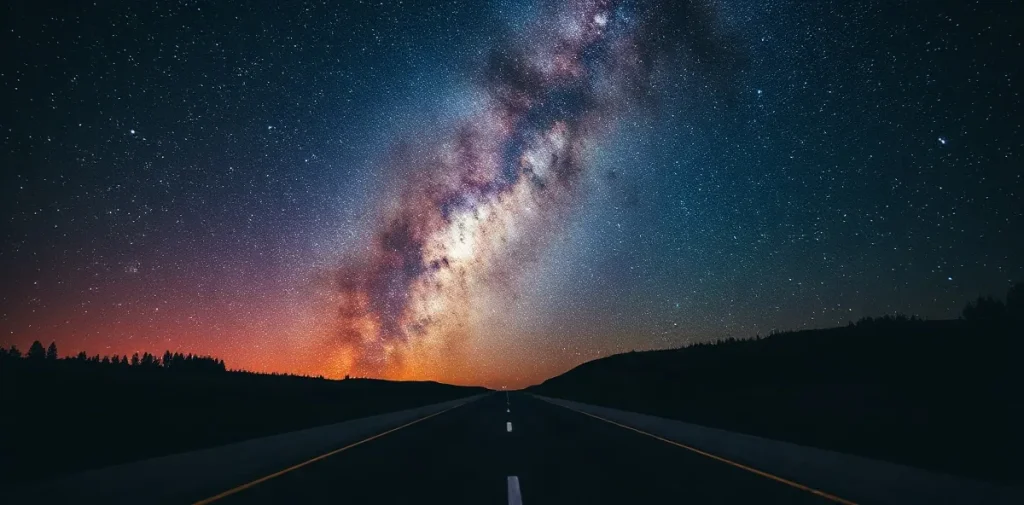
The Solar System is a small part of the Milky Way: the Sun is one of its stars, and the planets orbit it. Beyond our star system lie billions of other star systems and galaxies, forming a much larger structure: the Universe.
To understand Earth’s place in this cosmic neighborhood, it helps to look at the Solar System on two scales at once: as a family of planets orbiting one star, and as a resident of a galaxy among many stars. For more on how these objects are structured and connected, read our overview, “Stars and Galaxies: How the Universe’s Main Objects Are Structured and Connected.”
| Object | What it is | Connection to the Solar System |
|---|---|---|
| The Sun | Star | The system’s central star |
| Solar System | Planetary system | Part of the Milky Way |
| Milky Way | Galaxy | Contains the Solar System |
| Interstellar medium | Diffuse matter between stars | Lies beyond the heliosphere |
- 1 The Sun is one star in the Solar System
- 1 The Solar System is located in the Milky Way
- 1 The Sun orbits the center of the Milky Way
Where is the Solar System in the Milky Way?
The Solar System lies in the Milky Way’s disk, far from its center: the Sun is located in one of the galaxy’s spiral regions. The Milky Way is a spiral galaxy, so the Sun is surrounded by stars and interstellar matter in its disk; it is not at some special center of the galactic structure.
What lies hidden at the galactic center
Dense clouds of gas and dust obscure the galactic center, making it difficult to see in ordinary visible light. Astronomers therefore study the central region of the Milky Way in, among other bands, infrared and radio wavelengths: this radiation can reveal objects through the obscuring matter.
Beyond the Milky Way, the next level of our cosmic neighborhood is the Local Group of galaxies, which includes our galaxy. Thus, the Solar System’s location can be described on two scales: within the disk of the spiral Milky Way and within a larger group of galaxies.
How does the Sun move with the galactic disk?
The Sun orbits the center of the Milky Way, and the planets, including Earth, move along with it. One complete orbit of the Sun along this path is called a galactic year. It describes the star’s journey with the Solar System around it; it is not a unit for counting Earth years.
The galactic year and the motion of stars
An Earth year is defined by Earth’s orbit around the Sun; a galactic year is defined by the Sun’s orbit around the center of the Milky Way. These are two different motions and two different cycles: Earth completing one orbit around the Sun does not mean that the Sun has completed an orbit around the Galaxy.
The stars in the galactic disk do not form a fixed pattern: each moves along its own orbit around the center of the Milky Way. The Sun therefore changes position relative to neighboring stars over time, even as the planets continue to accompany it on its journey through the Galaxy.
How does the interstellar medium differ from Earth’s surroundings?
The interstellar medium differs from Earth’s surroundings in its composition and conditions: Earth and the planets lie inside the heliosphere, while beyond its boundary begins interstellar space, containing diffuse gas, dust, and charged particles. Earth’s solar surroundings are shaped by the stream of charged particles from the Sun—the solar wind—which also affects interstellar particles that reach the heliosphere’s boundaries.
The heliosphere is a transition, not a wall
The heliosphere’s boundary is not like a solid shell: it is a transition region where the solar wind interacts with the interstellar medium. The boundary between them therefore cannot be pictured as a sharp surface beyond which all conditions change instantly.
The planets move inside the heliosphere, within the region influenced by the solar wind; the interstellar medium begins beyond its boundary. But “interstellar” does not mean “empty”: it contains diffuse gas, dust, and charged particles. The interaction between these particles and the solar wind creates the transition between the Sun’s surroundings and the medium between stars.
How do you distinguish the Solar System, a star, and a galaxy?
The Sun is a star, the Solar System is a system of planets and smaller bodies associated with it, and the Milky Way is the galaxy that contains the Solar System. These are three different levels of cosmic structure: an individual star, the system around it, and a vast collection of stars, gas, dust, and other components.
The Sun is a star—the central light source of our system. The planets orbit it, along with other bodies bound to it, including asteroids and comets; together, they form the Solar System. So the term “Solar System” refers neither to the Sun alone nor to a separate galaxy, but to the star and the objects around it.
The Milky Way is a galaxy containing many stars, gas, dust, and other components. The Solar System is located within the Milky Way and is only part of it, not an independent galaxy. For a broader perspective, read our overview, “Stars and Galaxies: How the Universe’s Main Objects Are Structured and Connected.”
What misconceptions make it hard to picture our place in the Galaxy?
Errors of scale and frame of reference can make it difficult to picture the Solar System’s place in the Galaxy: the Sun is moving, the heliosphere is not the same as the planetary system, and a flat diagram of the Milky Way does not, by itself, convey exact distances. Images and estimates should therefore be interpreted with attention to what they show and what the motion is measured relative to.
What is often shown incorrectly
- A stationary Sun. The Sun is not at rest: it moves along its galactic orbit together with the planets and other bodies in the Solar System. Its position may look fixed in a diagram only because the motion is shown relative to a chosen frame or is not shown at all.
- The heliosphere as the boundary of the entire Solar System. The planetary system consists of the Sun and the bodies orbiting it; the heliosphere is the region affected by the solar wind. The concepts are related, but they are not interchangeable.
- The Milky Way as an accurate flat map. A diagram without a scale or a method for determining distances does not let you treat the intervals shown as exact. It helps illustrate the structure, but it does not replace measurements.
The Sun’s speed also cannot be stated without specifying the reference point: motion relative to the galactic center and motion relative to nearby stars describe different relationships. A specific speed estimate therefore makes sense only when its reference frame is given; without it, the number may misleadingly suggest that both refer to the same measurement.
Frequently asked questions
Is the Solar System in the Milky Way?
Is the Sun a galaxy?
What lies beyond the heliosphere?
Is the Solar System moving?
Key takeaways
- The Solar System is part of the Milky Way’s disk.
- The Sun and planets travel together in orbit around the galactic center.
- The heliosphere separates the region influenced by the solar wind from the interstellar medium.
- The Sun is a star, the Solar System is a planetary system, and the Milky Way is a galaxy.
